
Campervan Fridge Power Consumption Explained: How Much Battery & Solar Do You Need?
Discover how many watts a 12V fridge uses, how long it can run from a leisure battery and how much solar power you might need for off-grid campervan adventures.
Understanding campervan fridge power consumption is one of the most important steps when planning your leisure battery and solar charging system.
Your fridge is different from most other campervan appliances because it needs to keep food cold throughout the day and night.
However, that doesn’t necessarily mean it draws its full rated power continuously.
Most 12V compressor fridges automatically switch their compressor on and off to maintain the selected temperature.
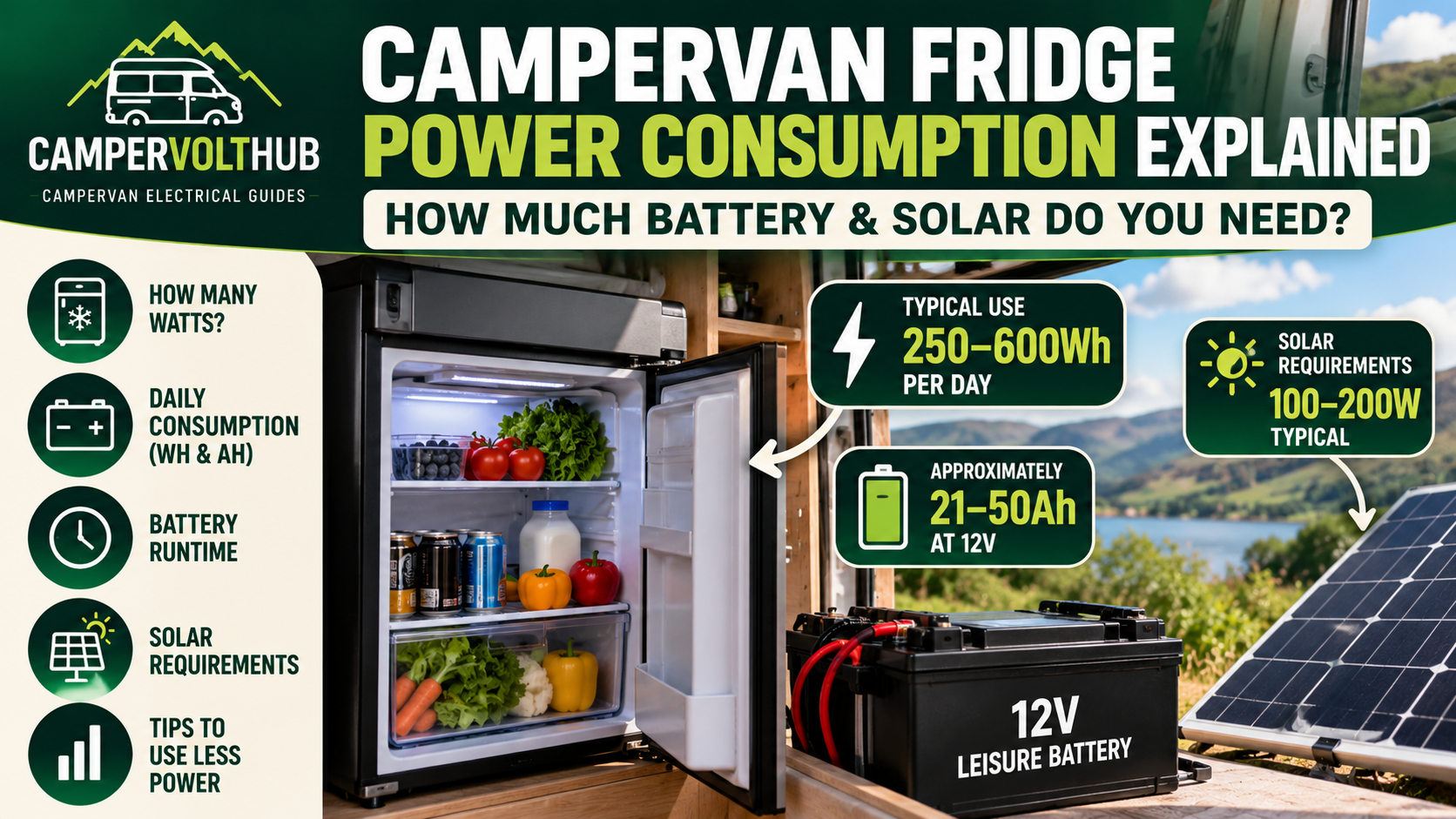
The electricity a fridge consumes depends on its design, size, ambient temperature, thermostat setting and how often the compressor runs.
In this guide, we’ll look at realistic planning examples, explain watts and amp-hours, calculate battery runtime and explore how solar charging can help keep your fridge running.
What Types of Fridges Are Used in Campervans?
Different fridge technologies use electricity in different ways.
Before calculating battery requirements, it’s important to identify the type of fridge you’re using.
12V Compressor Fridge
A compressor fridge uses a motor-driven refrigeration system to cool its interior.
Once the required temperature is reached, the compressor normally switches off until further cooling is needed.
This makes purpose-built 12V compressor fridges a popular option for battery-powered campervans.
Absorption Fridge
Absorption fridges are commonly found in traditional motorhomes and caravans.
Many three-way models can operate using LPG, 230V mains electricity or a 12V heating element.
The 12V mode can require substantial electrical energy and is commonly intended for use while driving, depending on the appliance.
Thermoelectric Cool Box
Thermoelectric cool boxes use a Peltier cooling system rather than a compressor.
Many draw power for much of the time they are switched on.
This can make their daily energy consumption surprisingly high.
230V Domestic Fridge
Some campervan conversions use a domestic fridge powered through an inverter.
This can work, but you must account for inverter conversion losses, standby consumption and compressor starting requirements.
Campervan Fridge Types Compared
| Fridge type | Power source | Operating behaviour | Battery suitability |
|---|---|---|---|
| 12V compressor | DC supply | Cycles on and off | Often well suited to off-grid use |
| Absorption | LPG, 230V or 12V on suitable models | Heat-driven cooling | 12V operation can be demanding |
| Thermoelectric | Usually 12V DC | May run for long periods | Can drain smaller batteries quickly |
| Domestic compressor | 230V AC | Cycles on and off | Requires a suitable inverter off-grid |
How Many Watts Does a 12V Campervan Fridge Use?
As a broad illustration, many small and medium-sized 12V compressor fridges draw roughly 35–65W while the compressor is running.
Actual running power varies by model, operating mode and conditions.
A fridge drawing 45W does not necessarily consume 45W continuously throughout the day.
Example: A 45W Compressor Fridge
If the compressor runs for eight hours in total during a 24-hour period:
Daily electrical energy consumed
At a nominal 12V:
Approximately 30 amp-hours per day
- Watts (W): Electrical power at a particular moment.
- Watt-hours (Wh): Total energy consumed over time.
- Amp-hours (Ah): Electrical charge, related to energy through system voltage.
Does a Campervan Fridge Run Continuously?
Most compressor fridges cycle on and off.
The percentage of time the compressor operates is called its duty cycle.
- 25% duty cycle = 6 hours per day
- 33% duty cycle = approximately 8 hours
- 50% duty cycle = 12 hours
- 75% duty cycle = 18 hours
A fridge in a hot van may run much longer than the same fridge in cooler conditions.
How to Calculate Campervan Fridge Power Consumption
Method 1: Use the Manufacturer’s Energy Specification
Where available, use the fridge manufacturer’s published 24-hour energy consumption.
Look for figures such as:
- Wh per 24 hours
- kWh per 24 hours
- Ah per 24 hours
- Average daily energy use
For example, if a fridge is specified at 0.36kWh per day:
Equivalent to approximately 30Ah at nominal 12V
Method 2: Estimate Using Duty Cycle
If you know the compressor running power, you can estimate consumption using the duty cycle.
Use 0.40 for a 40% duty cycle.
Worked Example
Suppose a compressor fridge draws 45W while running and operates for 40% of each day.
432Wh ÷ 12V = 36Ah per day
This is an estimate. Real consumption may also include control electronics and other small electrical loads.
12V Fridge Power Consumption Examples
The following examples show how compressor running time changes daily consumption.
| Duty cycle | Running hours per day | Energy per day | Approx. Ah at 12V |
|---|---|---|---|
| 25% | 6 hours | 270Wh | 22.5Ah |
| 33% | 7.9 hours | 356Wh | 29.7Ah |
| 40% | 9.6 hours | 432Wh | 36Ah |
| 50% | 12 hours | 540Wh | 45Ah |
| 75% | 18 hours | 810Wh | 67.5Ah |
Illustrative calculations for a fridge drawing 45W when the compressor is running. Actual consumption will vary.
How Much Leisure Battery Do You Need for a Campervan Fridge?
The battery capacity you need depends on three main factors:
- How much energy your fridge uses daily.
- How many days you want to run without charging.
- How much usable energy your battery can provide.
Step 1: Calculate Daily Consumption
Let’s use an example fridge consuming 360Wh per day.
Step 2: Choose Your Off-Grid Duration
For two days without charging:
Usable energy required for the fridge alone
Step 3: Account for Usable Battery Capacity
For a simplified example, suppose a lithium battery system is planned around 90% usable capacity.
800Wh ÷ 12V ≈ 67Ah nominal battery capacity
Under these assumptions, around 67Ah of nominal 12V battery capacity would be needed for the fridge alone.
You would normally choose a suitable battery size with allowance for other appliances, reserve capacity and operating conditions.
What About AGM or Lead-Acid Batteries?
Lead-acid batteries are often planned around a smaller usable proportion of their nominal capacity.
Using a simplified 50% planned usable capacity:
1,440Wh ÷ 12V = 120Ah nominal battery capacity
These examples use nominal 12V values and simplified capacity allowances. Actual usable energy depends on the battery and its operating conditions.
Read our campervan leisure battery guide for more information.
How Long Will a 12V Fridge Run on a Leisure Battery?
The following table estimates fridge-only runtime for a fridge using 360Wh per day.
The calculations assume a nominal 12V battery, 90% planned usable capacity for lithium and 50% for lead-acid.
| Battery type | Planned usable energy | Estimated runtime |
|---|---|---|
| 50Ah lithium | 540Wh | 1.5 days |
| 100Ah lithium | 1,080Wh | 3 days |
| 200Ah lithium | 2,160Wh | 6 days |
| 100Ah lead-acid | 600Wh | 1.7 days |
| 200Ah lead-acid | 1,200Wh | 3.3 days |
Will a 100Ah Lithium Battery Run a Fridge for Three Days?
Potentially, under the assumptions used above.
But if your fridge consumes 600Wh per day, the same planned 1,080Wh usable energy would last approximately 1.8 days.
That’s why knowing your actual fridge consumption matters.
Calculate Your Campervan Battery Size for Free
Your fridge is only one part of your campervan electrical system.
Our free CamperVoltHub Power Calculator lets you include your fridge, lighting, water pump, laptop, phone chargers and 230V appliances.
Estimate your daily energy consumption, battery requirements and approximate solar needs in one place.
Open Free Campervan Power Calculator →How Much Solar Do You Need to Run a Campervan Fridge?
Solar requirements depend on your fridge’s daily energy consumption and the amount of usable sunlight available.
For a simple estimate, you can use:
A simplified solar panel sizing formula
Peak sun hours represent the equivalent number of hours of full-strength solar irradiance.
They are not the same as total daylight hours.
Example: A Fridge Using 360Wh per Day
Assume:
- 360Wh daily consumption
- 3 peak sun hours
- 80% overall system efficiency
Calculated panel rating under these assumptions
This suggests that approximately 150W of rated solar capacity could replace 360Wh during a day with those assumed conditions.
However, real solar production varies considerably with weather, season, orientation and shading.
Solar Requirements at Different Sunlight Levels
| Peak sun hours | Assumed efficiency | Calculated panel rating |
|---|---|---|
| 1 hour | 80% | 450W |
| 2 hours | 80% | 225W |
| 3 hours | 80% | 150W |
| 4 hours | 80% | 113W |
| 5 hours | 80% | 90W |
Illustrative calculations for 360Wh daily consumption and 80% assumed system efficiency. These are not UK weather forecasts or guaranteed generation figures.
Can a 100W Solar Panel Run a Campervan Fridge?
A 100W panel may generate enough energy to offset some or all of an efficient fridge’s consumption on favourable days.
However, it cannot be relied upon to replace the same amount of energy every day, particularly in the UK.
What About Winter Solar in the UK?
Winter solar generation can be much lower than summer output.
Shorter days, low sun angles and cloud cover can significantly reduce charging.
For year-round off-grid use, consider battery capacity and alternative charging sources rather than relying on solar alone.
Read our campervan solar panel guide for more information.
Can a DC-DC Charger Help Keep Your Fridge Running?
Yes. A suitable DC-DC charger can recharge your leisure battery from the vehicle’s electrical system while driving.
This can be useful when solar production is limited or your campervan is parked in poor weather.
The charging current must be suitable for the vehicle, alternator, charger and leisure battery.
Explore our campervan DC-DC charger guide.
7 Things That Affect Campervan Fridge Power Consumption
Ambient Temperature
The hotter the surrounding air, the harder the fridge normally has to work. A fridge in a hot van can use considerably more electricity than in cooler conditions.
Ventilation
A compressor fridge needs to release heat. Restricted airflow can increase compressor running time and reduce efficiency. Follow the manufacturer’s clearance and ventilation requirements.
Thermostat Setting
A colder setting usually requires more cooling work. Choose an appropriate food-safe temperature rather than unnecessarily overcooling the fridge.
Door Opening
Every time the door opens, warm air can enter the fridge. Frequent opening increases cooling demand.
Adding Warm Food and Drinks
A fridge needs additional energy to cool newly added warm items. A large warm food load can increase compressor running time for hours.
Fridge Size and Insulation
Larger fridges may have greater cooling requirements, although efficiency varies between designs. Good insulation and door seals help reduce heat gain.
Wiring and Supply Voltage
Excessive voltage drop can cause a fridge’s low-voltage protection to operate.
If the fridge cuts out unexpectedly, measure its supply voltage under load and check the manufacturer’s diagnostic instructions.
How to Measure Your Fridge’s Actual Power Consumption
If you already own a campervan fridge, measuring its real daily consumption can improve your battery calculations.
Use a Battery Monitor
A properly installed battery monitor with a suitable shunt can measure energy entering and leaving your battery system.
However, it normally measures all connected loads together.
To estimate fridge-only consumption, other loads need to be accounted for.
Use a Suitable DC Energy Meter
A correctly rated DC energy meter can record consumption from an individual 12V appliance.
For useful results, measure over at least 24 hours in representative conditions.
What Should You Record?
- Energy used over 24 hours in Wh
- Ambient temperature
- Fridge temperature setting
- Whether the fridge was already cold
- How often the door was opened
- Whether a freezer compartment was used
6 Ways to Reduce Campervan Fridge Power Consumption
1. Improve Ventilation
Keep manufacturer-specified ventilation openings clear and allow adequate airflow around the condenser.
2. Keep the Door Closed
Organise food so you can find items quickly without leaving the door open unnecessarily.
3. Pre-Cool Before Travelling
Where practical, cool the fridge and contents using an appropriate power source before starting your trip.
4. Check Door Seals
Damaged or poorly fitting seals can allow warm air inside and increase cooling demand.
5. Use Sensible Settings
Maintain appropriate food-safe temperatures without unnecessarily selecting the coldest possible setting.
6. Compare Efficiency
When buying a fridge, compare published daily energy figures under equivalent test conditions.
5 Common Mistakes When Planning Campervan Fridge Power
Multiplying Running Watts by 24 Hours
This assumes the compressor runs continuously.
For a cycling compressor fridge, use a realistic duty cycle or a manufacturer-provided daily energy figure.
Assuming All Battery Capacity Is Usable
Usable energy depends on battery chemistry, temperature, battery condition and manufacturer limits.
Plan around an appropriate usable capacity allowance.
Ignoring Other Appliances
Lighting, heating controls, phone charging, water pumps and laptops also consume electricity.
Size your battery for the complete system, not just the fridge.
Assuming Solar Output Is Constant
A 200W solar panel does not produce 200W continuously throughout the day.
Real generation depends on weather, season, orientation and shading.
Forgetting Inverter Losses
A 230V fridge running through an inverter requires additional battery energy to cover conversion and standby losses.
Read our campervan inverter guide if you’re considering a domestic fridge.
Example: Planning a Weekend Campervan Fridge Setup
Let’s combine fridge consumption with a few other everyday electrical loads.
Example Daily Electrical Consumption
- 12V compressor fridge: 360Wh
- LED lighting: 40Wh
- Phone charging: 30Wh
- Water pump and small loads: 20Wh
Equivalent to 37.5Ah at nominal 12V
Two Days Without Charging
Total usable energy required
Lithium Battery Capacity
Using a 90% planned usable capacity allowance:
Approximately 83Ah at nominal 12V
Under these simplified assumptions, a suitable 100Ah lithium battery could provide enough planned usable energy for the two-day trip.
However, you should consider additional reserve, higher-than-expected loads and poor weather before finalising your battery choice.
Calculate Your Own Campervan Electrical Requirements
Enter your fridge, lighting, charging devices and other appliances into the free CamperVoltHub Power Calculator.
Calculate My Campervan Power Requirements →Campervan Fridge Power Consumption FAQs
How much electricity does a 12V campervan fridge use per day?
A compressor fridge might consume around 250–600Wh per day as a broad planning range, but actual consumption depends on the fridge model, temperature and use.
How many amps does a 12V fridge draw?
A fridge drawing 48W at 12V uses approximately 4A while running. Its average current over a full day may be lower because the compressor cycles.
How long will a 100Ah lithium battery run a fridge?
Using a nominal 12V battery, 90% planned usable capacity and 360Wh daily fridge consumption gives approximately three days for the fridge alone. Actual runtime will vary.
Can a 100W solar panel run a campervan fridge?
It may offset some or all of an efficient fridge’s consumption on favourable sunny days, but it cannot reliably cover daily demand in all UK conditions.
Does a campervan fridge run all the time?
Most compressor fridges cycle on and off. Their running time depends on cooling demand and operating conditions. Other fridge technologies behave differently.
Is a compressor fridge more efficient than an absorption fridge?
For battery-powered off-grid use, a purpose-built compressor fridge is often more electricity-efficient than operating an absorption fridge on its 12V heating mode. Absorption fridges may also use LPG on suitable installations.
Will a campervan fridge drain my starter battery?
It can if connected to the starter battery without appropriate battery protection or charging management. A dedicated leisure battery is commonly used to avoid affecting engine starting.
Why does my campervan fridge use more power in summer?
Higher ambient temperatures increase the amount of heat the fridge must remove, often causing the compressor to run for longer.
Do I need an inverter for a 12V fridge?
A fridge designed for direct 12V DC operation generally does not need a 230V inverter. A domestic 230V fridge needs a suitable AC supply.
What is the best way to calculate fridge battery requirements?
Start with daily energy consumption in Wh, multiply by the number of days required and allow for usable battery capacity and other electrical loads.
Related CamperVoltHub Guides & Tools
Final Thoughts: How Much Power Does a Campervan Fridge Really Need?
A campervan fridge can be one of the most important electrical loads in your conversion.
But choosing a leisure battery or solar panel based only on its running wattage can lead to inaccurate results.
For a compressor fridge, the most useful figure is its total energy consumption over 24 hours.
Start with the manufacturer’s published consumption figure or measure the fridge under representative conditions.
Then calculate your required off-grid duration, allow for usable battery capacity and include your other electrical loads.
Finally, consider how solar, alternator charging and mains hook-up will replace the energy you use.
Ready to Plan Your Campervan Electrics?
CamperVoltHub provides free tools and practical guides to help you understand your power requirements before buying equipment.
Start With the Free Power Calculator →About CamperVoltHub
CamperVoltHub is an independent UK resource focused on campervan electrical systems, leisure batteries, solar charging, DC-DC chargers, inverters and electrical fault finding.
Our aim is to make campervan electrical planning easier to understand through practical guides, calculations and free planning tools.
Disclaimer: All fridge consumption, battery runtime and solar calculations are illustrative planning estimates. Actual performance depends on equipment, battery chemistry, temperature, installation and operating conditions. Follow manufacturer instructions and appropriate electrical safety requirements.