
Campervan Battery Charges While Driving But Not on Solar?
Your leisure battery happily charges when you’re driving, but the moment you park up, your solar panels seem to go on holiday. Sound familiar?
Don’t start ordering expensive replacement parts just yet. Let’s work through the system and find out what’s actually wrong.
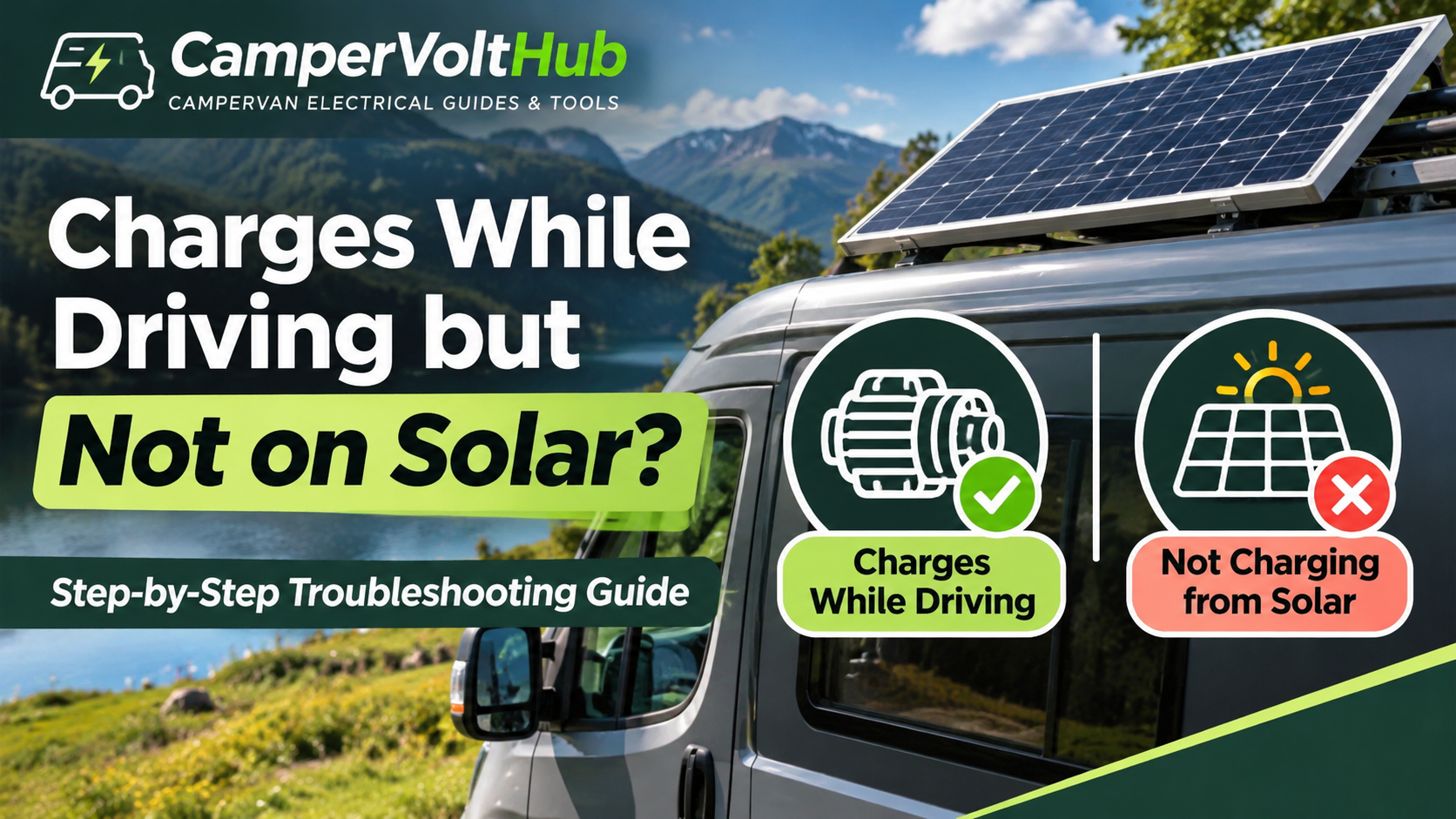
If your leisure battery charges while driving but not from solar, the fault is often somewhere in the solar charging system rather than the battery itself.
Common causes include insufficient sunlight, a blown fuse, damaged wiring, a faulty MPPT controller, incorrect charging settings or a battery management system preventing charging.
The trick is to work out whether electricity is reaching the solar controller and whether that controller is successfully delivering charge to the leisure battery.
When it comes to campervan electrics, I’m a big believer in methodical fault finding.
Start with what works, identify what doesn’t, and follow the electrical path until you find where things have gone wrong.
It’s a much better approach than buying a new solar panel, a new MPPT controller and a new battery just because one of them might be faulty.
Your wallet will thank you, and you’ll have more money left for the important things — like fuel, campsites and a decent breakfast on your travels!
Why Does My Leisure Battery Charge While Driving but Not From Solar?
The first thing to understand is that many campervans have two separate battery charging systems.
When you’re driving, your alternator supplies power to a DC-DC charger. The charger regulates the voltage and current delivered to your leisure battery.
When you’re parked, your solar panels generate electricity from sunlight. A solar charge controller, usually an MPPT, converts that power into a suitable battery charging output.
Because these systems use different charging paths, one can work perfectly while the other has a problem.
So if your DC-DC charger is working, that’s useful information.
It suggests your battery can accept charge under those conditions, but it doesn’t automatically mean every part of your battery system is fault-free.
Our complete campervan solar panel installation guide explains solar panels, MPPT controllers, wiring, mounting and battery charging.
Five Simple Checks Before You Start Fault Finding
Before grabbing the multimeter, let’s check the obvious things first.
You’d be surprised how often a complicated electrical problem turns out to be something straightforward.
1. Check the Sunlight
Heavy cloud, winter weather, dirty panels and shadows can dramatically reduce output. A 200W panel won’t produce 200W just because the sun briefly appears.
2. Check Battery Charge
If your battery is already full, the MPPT may reduce charging current to almost nothing. This can be completely normal.
3. Check the MPPT Display
Look for PV voltage, solar power, battery voltage, charging current and error codes. These readings are valuable clues.
4. Check Isolators and Fuses
A switched-off solar isolator, blown fuse or poor connection can interrupt charging. Never bypass a fuse or fit a larger one.
5. Check Battery Warnings
Lithium batteries can refuse charging because of low temperature, high voltage or another BMS protection condition.
Bonus: Check Your Appliances
Your solar panels might be charging, but your fridge and other appliances could be using most of the electricity.
How to Diagnose a Campervan Solar Charging Fault
Now let’s get into the proper troubleshooting. Work through the following checks in order.
Solar panels can produce live DC voltage whenever light reaches them.
Never unplug MC4 connectors under load, short panel cables, touch exposed live conductors or open live electrical enclosures.
Follow your equipment manufacturer’s isolation and reconnection instructions. Many MPPT controllers require the battery to be connected before the solar input.
If you’re not competent with electrical testing, have a qualified specialist perform the live measurements.
Confirm the Battery Needs Charging
First, check the battery’s state of charge. If it’s already fully charged, your solar controller may correctly be supplying very little current.
With lead-acid batteries, resting voltage can provide a rough indication of charge, but voltage measured during charging isn’t a reliable percentage reading.
For LiFePO4 batteries, voltage alone is even less useful because their voltage remains relatively stable across much of the usable capacity.
A correctly configured battery monitor or BMS app is generally more informative.
Check the MPPT Controller Readings
Open your controller’s app or look at its display.
Record these readings:
- Solar panel PV voltage
- Solar power in watts
- Battery voltage
- Charging current in amps
- Charging stage
- Any warning or error messages
These readings help determine whether the problem is on the solar input side or the battery charging side.
If the controller reports zero PV voltage in strong sunlight, investigate the solar input circuit.
If PV voltage is present but charge current is zero, the cause could be weak sunlight, a full battery, controller settings or battery protection.
Inspect the Solar Panels and Wiring
Check the parts of your installation that can be inspected safely without disturbing live connections.
- Look for cracked or damaged panels.
- Check for heavy dirt, leaves or shading.
- Look for visible cable damage.
- Check for signs of overheated connectors.
- Confirm accessible isolators are correctly positioned.
Remember that a solar panel can sometimes show voltage without delivering useful power under load.
Voltage alone doesn’t prove the entire solar circuit is working correctly.
More advanced testing should use the manufacturer’s panel specifications and be carried out by someone competent with DC electrical systems.
If you’re unsure how the panels and controller should be connected, read our complete campervan solar panel installation guide .
Check the MPPT Battery Connection
Your solar controller needs a suitable battery connection to operate correctly.
If the battery-side fuse has blown or a connection has failed, solar charging may stop even while the DC-DC charger continues working.
Depending on the controller, a missing battery connection can also prevent the unit from starting properly.
Follow the manufacturer’s diagnostic instructions and check any accessible protection devices safely.
Check Your MPPT Charging Settings
Incorrect controller settings can cause charging problems and potentially damage the battery.
Check the following:
- Correct battery chemistry
- Correct absorption voltage
- Correct float voltage where applicable
- Appropriate maximum charging current
- Temperature compensation settings
- Charging enable and remote on/off settings
Always compare these settings against the specifications supplied by your battery manufacturer.
Don’t simply copy another campervan owner’s settings because they use a similar-looking battery.
Check Whether Appliances Are Using the Power
Sometimes your solar system is working, but your battery monitor doesn’t show much charging.
Imagine your MPPT controller is supplying 8 amps while your fridge and other appliances are consuming 7 amps.
Only around 1 amp may be left to charge the battery.
Solar charging: 8A
Electrical loads: 7A
Net battery charging: approximately 1A
That’s not necessarily a fault. It’s a bit like filling the bath while somebody has left the plug slightly open!
Actual readings depend on your wiring arrangement and where the current sensors are installed.
Check Lithium Battery BMS Protection
If you have a LiFePO4 battery, its battery management system may temporarily prevent charging.
Possible reasons include:
- Low battery temperature
- High battery temperature
- Cell overvoltage
- Cell imbalance
- Overcurrent protection
- Other BMS faults
Many lithium batteries restrict charging around freezing temperatures, although the exact limit varies.
If your battery has Bluetooth, check its app for warnings and charging permission.
Understanding Your Solar Controller Readings
Learning what your MPPT controller is telling you makes electrical fault finding much easier.
| Reading | What It Means | What to Remember |
|---|---|---|
| PV Voltage | Voltage at the solar input | Voltage alone doesn’t prove useful power is available. |
| PV Power | Power being drawn from the panels | Changes with sunlight, shade and charging demand. |
| Battery Voltage | Voltage measured by the controller | Not an accurate battery percentage reading by itself. |
| Charge Current | Current supplied by the controller | May differ from net battery current. |
| Bulk | Main charging stage | Actual current depends on available power and limits. |
| Absorption / Float | Later charging stages | Current may naturally reduce. |
Why Does My MPPT Show Voltage but Zero Amps?
This is one of the most common questions about solar charging.
You open the controller app, see PV voltage, but the charging current shows 0A.
Before assuming the controller is faulty, ask yourself:
- Is the battery already full?
- Is there enough sunlight?
- Is the PV voltage high enough for the controller to start?
- Is the controller showing an error?
- Has the battery BMS stopped charging?
- Are the charging settings correct?
A controller may display PV voltage even when the available solar power is too low to provide useful charging.
Campervan Solar Charging Troubleshooting Table
Use this table to narrow down the likely cause of your problem.
| Symptom | Possible Cause | What to Check |
|---|---|---|
| No PV voltage | Open circuit, isolator off or panel fault | Solar input circuit and controller status |
| PV voltage but no charge current | Full battery, weak sunlight or BMS restriction | Battery state, PV power and controller errors |
| Controller has no power | Battery-side fuse or connection problem | Controller supply and protection |
| Intermittent charging | Shade, unstable input or wiring issue | PV history and visible wiring condition |
| Battery still goes flat | Loads exceed solar generation | Daily energy consumption and solar yield |
| Charging stops in cold weather | Lithium BMS protection | Battery temperature and BMS warnings |
| Problems after adding another panel | Incorrect wiring or exceeded controller limits | Array specifications and controller ratings |
Why Lithium Leisure Batteries Can Make Solar Troubleshooting Confusing
Lithium batteries are excellent for campervans, but their built-in protection systems add another thing to consider.
For example, a battery might refuse solar charging early on a freezing morning because the cells are too cold.
Later, after the van has warmed up, the same battery may happily accept charging from the DC-DC charger.
That doesn’t automatically mean the solar controller is faulty.
Some lithium batteries can also continue supplying electricity to appliances while refusing to accept charging current.
If your battery has a Bluetooth monitoring app, check its fault history and temperature readings.
Take screenshots of your battery and MPPT readings when the fault happens. Intermittent electrical problems are much easier to investigate when you’ve recorded what the system was doing.
What If You Have a Combined DC-DC and MPPT Charger?
Some modern campervan chargers combine alternator charging and solar charging in one unit.
In these systems, the solar input and alternator input may share some internal electronics.
If driving charges the battery but solar doesn’t, consult the exact manufacturer’s manual.
Check:
- Whether the solar input is enabled
- Minimum solar start-up voltage
- Maximum PV open-circuit voltage
- Maximum solar input current
- Ignition detection settings
- Charging source priority
- Fault codes and protection conditions
Different manufacturers handle simultaneous alternator and solar charging differently.
The correct wiring diagram and instructions for your particular charger should always take priority.
How Much Solar Power Should Your Campervan Actually Produce?
Before deciding that your solar system has failed, it’s worth understanding realistic output.
Let’s imagine you have a 200W solar panel.
If it receives the equivalent of three full-strength sunlight hours, the theoretical energy production would be:
That’s 600 watt-hours before allowing for real-world losses.
Actual production depends on sunlight, shading, panel angle, temperature, wiring and controller efficiency.
During winter in the UK, solar generation can be dramatically lower than during summer.
Short daylight hours, heavy cloud and low sun angles all reduce the available energy.
If your appliances use more electricity than the panels generate, your battery can continue losing charge even when the solar system is working.
That’s why understanding your daily electrical consumption is just as important as choosing the right solar panels.
How to Prevent Solar Charging Problems in the Future
Once you’ve found and fixed the fault, a few simple habits can help keep everything working reliably.
Keep Panels Clean
Remove dirt and debris using manufacturer-approved methods. Avoid unsafe roof access.
Monitor Solar Output
Check your daily energy production occasionally. You’ll soon learn what’s normal for your system.
Inspect Visible Wiring
Look for chafing, damaged insulation, poor cable support and overheating. Leave live testing to competent people.
Save Your Settings
Keep a record of MPPT settings, battery specifications and wiring diagrams.
If you’re planning an upgrade, our campervan solar panels guide explains how to choose suitable panels and charging equipment.
Frequently Asked Questions
Why does my leisure battery charge while driving but not when parked?
Your DC-DC charger may be working correctly while the solar charging system has insufficient sunlight, a wiring fault, incorrect settings or a battery charging restriction.
Can a blown fuse stop solar charging but not DC-DC charging?
Yes. If the solar controller has its own fused battery connection, a problem with that circuit can stop solar charging without affecting the DC-DC charger.
Can a solar panel show voltage but produce no charging current?
Yes. Voltage can be present even when there isn’t enough usable solar power to charge the battery. Charging may also be limited by the controller or battery.
Does an MPPT controller need the battery connected first?
Many MPPT controllers require the battery connection before the solar input. Always follow the instructions for your specific model.
Can cold weather stop lithium batteries charging from solar?
Yes. Many LiFePO4 batteries have low-temperature charging protection. The BMS may prevent charging until the cells reach a safe temperature.
Should I replace my MPPT controller if the battery isn’t charging?
Not before checking sunlight, battery condition, settings, wiring and protection devices. Replacing components without diagnosis can be an expensive guess.
Can I connect a solar panel directly to the battery to test it?
Don’t bypass the charge controller as a shortcut. Unregulated charging can damage equipment and create safety risks. Use approved diagnostic procedures instead.
Final Thoughts: Find the Fault Before Buying Replacement Parts
If your campervan leisure battery charges while driving but not from solar, the good news is that you already have a useful starting point.
At least one charging route is working.
From there, the sensible approach is to follow the solar charging system logically.
Check the sunlight, controller readings, battery condition, charging settings and electrical protection.
Don’t forget about electrical loads or lithium battery BMS restrictions.
Most importantly, don’t assume the most expensive component is the one that’s failed.
A little careful fault finding can save a lot of money — and leave more in the adventure fund.
That’s always a result!
Keep Your Campervan Powered for the Next Adventure
At CamperVoltHub, we make campervan electrics easier to understand.
Whether you’re planning your first 12V system or troubleshooting an annoying electrical fault, you’ll find practical guides, buying advice and helpful planning tools.
Explore CamperVoltHub Solar Installation GuideSafety disclaimer: This article provides general educational information. Always follow the instructions for your specific solar panels, controller and battery. Solar DC circuits can remain live in daylight, and batteries can deliver dangerous fault currents. Seek qualified assistance when necessary.