
Campervan Leisure Battery Draining Overnight? 9 Causes to Check
Is your leisure battery losing charge while your campervan is parked? Learn how to find hidden electrical loads, check battery condition and diagnose unexpected overnight power consumption.
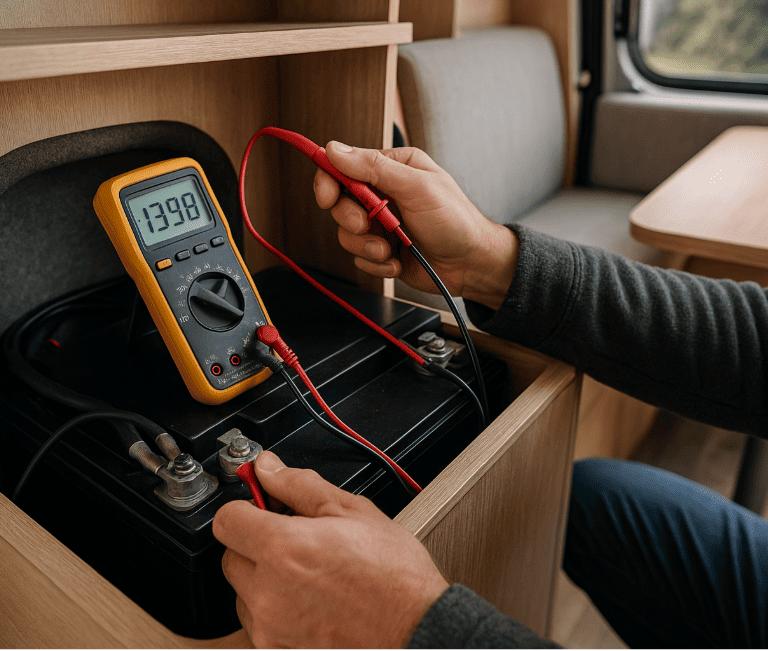
A campervan leisure battery can drain overnight because of excessive appliance consumption, inverter standby power, hidden electrical loads, incomplete charging, reduced battery capacity or inaccurate battery monitor readings.
The best approach is to measure how much electricity is actually leaving the battery, compare that figure with your expected overnight usage and investigate anything that doesn’t add up.
You park up for the evening, switch off the lights and settle in for the night. Everything seems fine until the following morning, when the leisure battery is showing a low charge or an appliance refuses to start.
It’s tempting to blame the battery immediately. But in my experience working with vehicle electrical systems, the sensible approach is to establish whether you’re dealing with normal power consumption, an unexpected electrical load or a battery that can no longer deliver its rated capacity.
Those three situations can produce similar symptoms, but the solutions are very different.
This guide explains nine possible causes, how to check them and when you should investigate the wiring or charging system rather than replace the battery.
Leisure batteries can supply extremely high short-circuit currents. Never bridge battery terminals, bypass fuses, disconnect high-current wiring under load or place a multimeter set to amps directly across a battery.
Follow manufacturer instructions and use appropriately rated test equipment. If you’re unfamiliar with electrical testing, have a competent automotive electrical technician investigate the system. Do not work on live 230V hook-up circuits.
How Much Battery Drain Is Normal Overnight?
Before looking for faults, you need to know how much electricity your campervan normally consumes.
A leisure battery supplies power to appliances even when the engine is off. Your fridge, lighting, USB sockets, heating controls and inverter can all contribute to overnight consumption.
The simplest way to estimate energy use is to calculate watt-hours.
Example: Overnight Campervan Electricity Usage
Imagine your campervan uses the following equipment during a 10-hour period:
| Appliance | Usage | Energy |
|---|---|---|
| Compressor fridge | 45W for 4 hours total | 180Wh |
| LED lights | 12W for 4 hours | 48Wh |
| Phone charging | 15W for 2 hours | 30Wh |
| Standby equipment | 3W for 10 hours | 30Wh |
| Total | Overnight | 288Wh |
At an illustrative average battery voltage of 12V, this represents:
On a nominal 100Ah battery, that is around 24% of its rated capacity. However, rated capacity is not the same as usable capacity.
Lead-acid batteries are often sized with a conservative depth-of-discharge allowance to preserve service life, while many LiFePO4 batteries allow a greater proportion of their rated capacity to be used.
For more accurate estimates, try our free Campervan Power Calculator .
9 Reasons Your Campervan Leisure Battery Drains Overnight
1. Your 12V Fridge Is Using More Power Than Expected
A compressor fridge is often one of the biggest regular electrical loads in a campervan.
Although the compressor cycles on and off, its running time can add up quickly, especially during warmer weather.
A fridge drawing 45W while running will use approximately 180Wh if its compressor runs for four hours overnight.
If the compressor runs for seven hours instead, consumption rises to approximately 315Wh.
Common reasons for increased consumption:- High internal campervan temperatures.
- Restricted fridge ventilation.
- Poorly sealing door gaskets.
- Very low thermostat settings.
- Warm food or drinks placed inside.
- Frequent door opening.
Measure the fridge’s actual energy consumption over a representative period and compare it with the manufacturer’s specifications.
A correctly installed DC energy monitor can help establish how much electricity the fridge uses.
2. Your Inverter Is Drawing Power on Standby
Many campervan inverters consume electricity whenever they’re switched on, even when no 230V appliance is connected.
This is called no-load or standby consumption.
The amount varies considerably between inverter models.
For example, an inverter using 15W continuously for 10 hours would consume:
That can be a significant amount of energy when you’re relying on a small leisure battery.
What to check:- Check the inverter’s no-load power specification.
- Measure battery current with the inverter on and off.
- Use a power-saving mode if available and appropriate.
- Switch off the inverter when it isn’t needed.
For inverter sizing and operation, visit our Campervan Inverter Guide .
3. Hidden Standby Loads Are Running All Night
Not every electrical load makes itself obvious.
Even when your main switch panel appears to be off, some devices may remain permanently powered.
Examples include:
- USB sockets with illuminated displays.
- Wi-Fi routers.
- Alarm and tracking systems.
- Heating control panels.
- Battery monitoring equipment.
- Televisions on standby.
- Electronic relay modules.
- Water tank monitoring systems.
Individually, these devices may use very little power. Together, they can create a noticeable overnight drain.
For example, a combined standby current of 0.6A over 10 hours uses:
Measure the steady battery discharge current after all obvious appliances are off.
Allow electronic modules enough time to enter their normal standby state.
Compare the measured current with the expected standby consumption of your installed equipment.
4. Your Leisure Battery Wasn’t Fully Charged
Sometimes the battery isn’t draining unusually quickly. It simply wasn’t fully charged when you parked.
Short journeys don’t always replace the electricity used during the previous day.
Charging performance depends on:
- DC-DC charger output.
- Alternator and vehicle charging conditions.
- Battery chemistry and temperature.
- Other electrical loads operating while driving.
- Charging duration and charger settings.
Replacing 50Ah at an average net charging current of 20A would theoretically take at least 2.5 hours.
Actual charging can take longer because charging current changes and some energy is lost.
What to check:Review your charging history, battery monitor readings and charger configuration.
If your battery isn’t charging properly while driving, investigate the charging system separately.
See our Campervan DC-DC Charger Guide .
5. Your Leisure Battery Has Lost Capacity
Batteries gradually lose usable capacity as they age.
This is particularly relevant to lead-acid batteries that have experienced repeated deep discharge, unsuitable charging or prolonged storage in a discharged condition.
Lithium batteries can also lose capacity, although their characteristics differ.
Imagine a battery originally rated at 100Ah now delivers only 60Ah under its current operating conditions.
Removing 24Ah overnight would represent 40% of that remaining capacity, rather than 24% of the original rating.
Possible symptoms:- Shorter runtime than previously.
- Voltage falling rapidly under load.
- Appliances switching off earlier than expected.
- Reduced measured discharge capacity.
Use a battery test appropriate for its chemistry and follow the manufacturer’s instructions.
Do not assume a battery is defective based on a single voltage reading.
For battery chemistry and capacity information, read our Campervan Leisure Battery Guide .
6. Your Battery Monitor Is Showing Incorrect Readings
A battery monitor showing a sudden drop in percentage doesn’t always mean the battery has lost that amount of energy.
Many monitors calculate state of charge by tracking current entering and leaving the battery.
Incorrect settings or installation problems can affect their accuracy.
Check for:- Incorrect battery capacity settings.
- Wrong battery chemistry configuration.
- Incorrect full-charge synchronisation.
- Loads bypassing the battery shunt.
- Charging circuits bypassing the shunt.
Lithium batteries have a relatively flat voltage profile through much of their operating range, so voltage alone is not a reliable percentage indicator.
Our Campervan Battery Shunt Guide explains how shunt-based monitoring works.
7. An Electrical Fault Is Causing Unexpected Current Draw
If your leisure battery is losing substantially more charge than expected, a wiring or component fault may be responsible.
Examples include:
- A relay remaining energised.
- An accessory wired to a permanent supply.
- An electronic module failing to enter sleep mode.
- A faulty appliance control circuit.
- Moisture-related electrical faults.
A severe short circuit should normally operate correctly designed circuit protection.
However, smaller unexpected loads may continue drawing current without blowing a fuse.
What to check:Measure the unexpected current draw and identify the circuit responsible using a wiring diagram and suitable diagnostic equipment.
Do not remove high-current fuses or disconnect battery cables while circuits are carrying load.
Our Campervan Wiring Diagram Builder can help you document your electrical layout.
8. Cold Weather Is Affecting Battery Performance
Battery performance changes with temperature.
Lead-acid batteries generally deliver less usable capacity at low temperatures.
Lithium iron phosphate batteries also have temperature-related limits.
Some lithium battery management systems restrict charging or discharging when temperatures fall outside their permitted range.
This can make the battery appear to have less available energy during cold weather.
What to check:- Battery temperature.
- Manufacturer operating limits.
- BMS warning messages.
- Whether charging was prevented by low temperature.
If your lithium battery refuses to charge in freezing conditions, read:
Campervan Lithium Battery Not Charging in Cold Weather .
Never bypass low-temperature battery protection.
9. Your Leisure Battery Is Supplying Unknown Circuits
Campervan electrical installations vary considerably.
Some conversions contain permanently connected accessories that aren’t controlled by the main 12V switch panel.
Examples include:
- Aftermarket alarm systems.
- Tracking devices.
- Heating controllers.
- Additional USB outlets.
- Charging interfaces.
- Other accessories added after conversion.
Incorrectly configured charging or switching equipment can also create unexpected electrical loads.
What to check:Compare the actual installation with its wiring diagram and identify every circuit supplied by the leisure battery.
If the starter battery is also losing charge, investigate both battery systems and any connections between them.
Leisure Battery Draining Overnight: Troubleshooting Table
| Symptom | Possible cause | First check |
|---|---|---|
| Battery loses charge with fridge running | Fridge energy consumption | Measure fridge usage over 24 hours |
| Battery drains with everything apparently off | Standby or parasitic load | Measure resting discharge current |
| Battery drains when inverter is on | Inverter standby consumption | Compare current with inverter on and off |
| Battery starts the night partly discharged | Incomplete charging | Review charging history |
| Runtime gradually becomes shorter | Reduced battery capacity | Appropriate battery capacity test |
| Monitor percentage changes unexpectedly | Monitor configuration or shunt problem | Check monitor settings |
| Problem is worse in freezing weather | Temperature-related performance | Check battery temperature and BMS |
| Both starter and leisure batteries lose charge | Shared circuit or charging-interface issue | Inspect system design and current paths |
How to Test Leisure Battery Drain With a Multimeter
A multimeter is useful for checking battery voltage and identifying unusual voltage behaviour.
However, a conventional multimeter is not always suitable for measuring the total current leaving a leisure battery.
For current measurements, a properly installed battery shunt or appropriately rated DC clamp meter is generally more practical.
Test 1: Check Battery Voltage
- Stop charging the battery using the approved controls.
- Switch off unnecessary electrical loads.
- Allow the battery voltage to settle where practical.
- Set the multimeter to DC volts.
- Measure across the battery terminals using appropriate safety precautions.
- Record the reading, temperature and recent charging activity.
For a conventional lead-acid leisure battery, resting voltage can provide a rough indication of state of charge.
| Approximate voltage | General lead-acid interpretation |
|---|---|
| 12.6–12.8V | Often consistent with a well-charged battery |
| 12.4V | Partially discharged |
| 12.2V | Significantly discharged |
| 12.0V | Substantially discharged |
| Below 12.0V | Low charge or another condition requiring investigation |
Illustrative values only, assuming adequate rest and no significant load or charging current. Actual voltage varies with battery chemistry, temperature and condition. These values must not be used as a LiFePO4 state-of-charge table.
Test 2: Measure Parasitic Current Draw
The most useful test for unexpected overnight discharge is measuring the net current leaving the leisure battery.
You can do this using:
- A correctly installed battery monitor with a current-measuring shunt.
- A suitably rated DC clamp meter around a single appropriate battery conductor.
Never connect a multimeter set to current measurement directly across battery terminals.
This can cause a dangerous short circuit through the meter.
Do not insert an ordinary multimeter into a main battery circuit unless the procedure and equipment are specifically suitable for the possible current.
Test 3: Compare Expected and Actual Drain
After switching off unnecessary equipment, record the steady discharge current.
Some electronic modules need time to enter their normal sleep state.
Compare the result with the expected consumption of the equipment installed.
| Constant current | 10-hour drain | 24-hour drain |
|---|---|---|
| 0.1A | 1Ah | 2.4Ah |
| 0.25A | 2.5Ah | 6Ah |
| 0.5A | 5Ah | 12Ah |
| 1A | 10Ah | 24Ah |
| 2A | 20Ah | 48Ah |
| 3A | 30Ah | 72Ah |
These are calculation examples, not universal acceptable standby-current limits. They assume constant current without charging.
Test 4: Find the Circuit Responsible
- Record the baseline discharge current.
- Switch off optional equipment using its intended controls.
- Allow control modules to enter standby.
- Observe any change in current.
- Compare the result with your wiring diagram.
- Investigate the suspect circuit using safe, manufacturer-approved diagnostic procedures.
Always establish the actual current draw before replacing parts.
If switching off a particular appliance causes a large reduction in current, you’ve found an important clue. You still need to establish whether that consumption is normal for the appliance or caused by a fault.
How Much Overnight Battery Drain Is Too Much?
It depends on the battery’s usable capacity, starting state of charge and the equipment running.
Consider these illustrative examples:
| Battery type | Example usable capacity | 20Ah overnight drain |
|---|---|---|
| 100Ah lead-acid | 50Ah planning allowance | 40% of usable allowance |
| 100Ah LiFePO4 | 90Ah planning allowance | Approximately 22% |
| 200Ah LiFePO4 | 180Ah planning allowance | Approximately 11% |
These are example planning allowances, not universal battery specifications. Actual usable capacity depends on manufacturer limits, temperature and battery condition.
How to Stop Your Leisure Battery Draining Overnight
- Measure your electricity use: Work out how much energy each appliance consumes.
- Switch off unnecessary loads: Particularly inverters and accessories with standby consumption.
- Improve fridge efficiency: Maintain ventilation and door seals.
- Check charging performance: Confirm the battery is properly charged before parking.
- Check battery condition: Use a suitable test if capacity loss is suspected.
- Verify battery monitor settings: Incorrect settings can misrepresent state of charge.
- Investigate abnormal current: Find the responsible circuit rather than replacing components at random.
- Review battery capacity: Make sure the system can support your actual overnight use.
Should You Upgrade to a Bigger Leisure Battery?
A bigger battery can provide longer runtime, but it won’t repair an electrical fault.
Before upgrading, establish how much energy your campervan actually consumes and whether the existing battery is delivering its expected capacity.
If normal overnight consumption exceeds available storage, increasing capacity may be worthwhile.
Any upgrade must be compatible with the charging equipment, wiring, protection and battery installation.
Calculate Your Campervan’s Battery Needs
Not sure how much electricity you’re using overnight? Our free calculator helps estimate daily consumption and battery requirements.
Try the Free Campervan Power Calculator →Frequently Asked Questions
Why does my leisure battery go flat overnight?
Common causes include excessive appliance consumption, inverter standby power, hidden electrical loads, incomplete charging, reduced battery capacity and inaccurate monitoring. Measure actual discharge before replacing the battery.
Can a leisure battery drain when everything is off?
Yes. Permanently powered equipment such as alarms, monitoring systems and electronic controllers may continue using power. An unexpected load may also indicate a fault.
How much charge should a leisure battery lose overnight?
There is no universal amount. It depends on your appliances, their running time and your battery’s usable capacity. Measure overnight amp-hours or watt-hours to establish whether consumption is normal.
Will leaving my inverter on drain the battery?
Many inverters consume electricity even without a connected AC load. Check the model’s no-load consumption and switch it off when not required.
Can a faulty battery discharge itself overnight?
Yes. Internal deterioration or faults can contribute to abnormal self-discharge or reduced capacity. However, connected loads and incomplete charging should also be investigated.
Can cold weather drain a leisure battery?
Cold conditions can reduce available battery performance. The effect depends on battery chemistry and operating conditions. Some lithium batteries also restrict operation through their BMS.
How do I test for parasitic battery drain?
Measure net discharge current with a correctly installed battery shunt or suitable DC clamp meter. Compare it with expected standby consumption, then investigate any unexpected circuits safely.
Is a 100Ah leisure battery enough for one night?
It may be, depending on battery chemistry, condition, starting charge and appliance consumption. Calculate your expected overnight energy demand before deciding.
Final Thoughts
If your campervan leisure battery keeps draining overnight, the best starting point is to measure rather than guess.
Establish your normal electrical consumption, confirm the battery is properly charged and check for unexpected current draw.
If the measured consumption is normal but runtime is still poor, investigate the battery’s usable capacity and condition.
In many cases, a systematic diagnosis can identify the cause without unnecessary replacement of batteries or charging equipment.
Safety note: This guide provides general educational information. Always follow manufacturer instructions and appropriate electrical safety procedures. Seek competent professional assistance when required.
2 thoughts on “Campervan Leisure Battery Draining Overnight? 9 Causes to Check”