
Campervan Lithium Battery Not Charging in Cold Weather: Causes, BMS Protection & Fixes
Why LiFePO4 leisure batteries stop charging in freezing conditions, how to identify low-temperature BMS protection, and what you can safely do about it.
If your campervan lithium battery is not charging in cold weather, the problem may not be your solar panels, DC-DC charger or mains battery charger.
Many lithium iron phosphate (LiFePO4) leisure batteries have built-in protection that prevents charging when their internal cells become too cold.
This can be confusing because your campervan lights, fridge and other 12V appliances may continue working normally, even though the battery is refusing to accept charge.
In many cases, the battery management system is doing exactly what it was designed to do: protecting the cells from potentially damaging charging conditions.
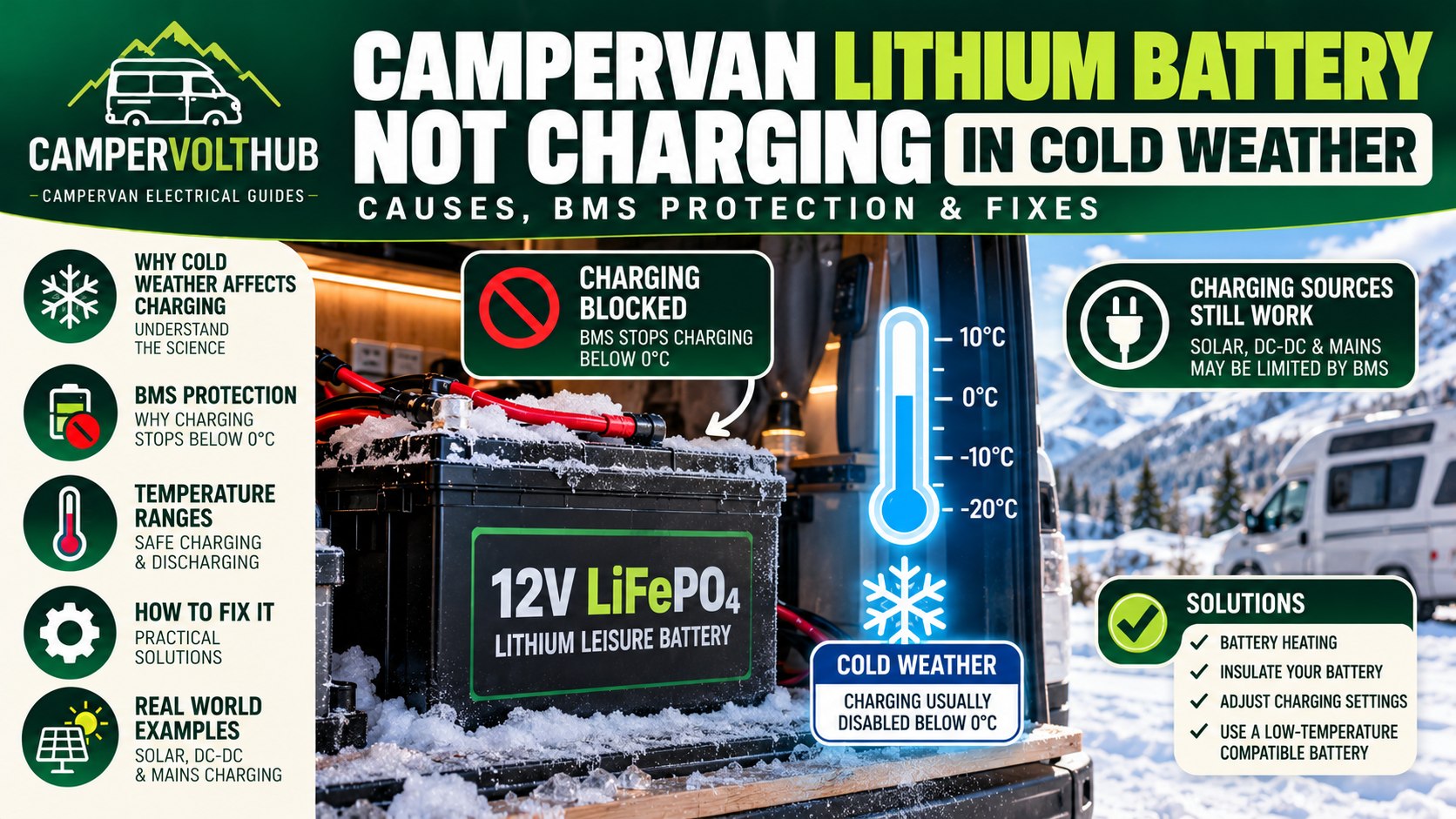
In this guide, we’ll explain why cold weather affects lithium charging, how low-temperature BMS protection works, how to diagnose the problem and which solutions are appropriate for winter campervan use.
Why Do Campervan Lithium Batteries Stop Charging in Cold Weather?
Lithium iron phosphate batteries use chemical reactions to store and release electrical energy.
When temperatures fall, the internal processes in the battery slow down.
Charging a lithium battery below its permitted temperature range can increase the risk of unwanted lithium metal depositing on the negative electrode.
This process is commonly known as lithium plating.
Lithium plating can reduce battery capacity, damage internal cells and create additional safety risks.
For this reason, many LiFePO4 leisure batteries are designed to stop or restrict charging when the cells become too cold.
Does the Battery Have to Be Frozen?
No. The problem is not necessarily that the battery electrolyte has physically frozen.
The charging restriction relates to how the internal lithium cells behave at low temperatures.
A battery can therefore be too cold to charge even though its casing and internal components are not physically frozen.
What Temperature Is Too Cold to Charge a LiFePO4 Battery?
There is no single charging temperature limit that applies to every lithium leisure battery.
Many conventional LiFePO4 batteries restrict charging at around 0°C, but some manufacturers specify a higher minimum temperature.
For example, certain Victron lithium battery models specify a minimum charging temperature of +5°C. Other designs have different limits.
| Battery temperature | General consideration | Recommended approach |
|---|---|---|
| Above +10°C | Generally within the charging range of many LiFePO4 batteries | Follow normal manufacturer charging limits |
| +5°C to +10°C | Charging may be permitted, sometimes with current restrictions | Check specified current and temperature limits |
| 0°C to +5°C | Some batteries allow charging; others may block it | Follow the exact battery specification |
| Below 0°C | Standard batteries commonly block charging | Use an approved heating or warming solution |
| Very low temperatures | Charging and discharge performance may both be restricted | Check operating and storage limits |
This table provides general guidance rather than universal operating limits. Manufacturer-specific data always takes priority.
Air Temperature vs Battery Temperature
A common mistake is assuming the outside air temperature is the same as the battery’s internal temperature.
For example:
- The outside air may be -3°C.
- The campervan interior may be +12°C.
- The battery inside an insulated seat base may still be +7°C.
Alternatively, a battery installed in an unheated external locker may remain close to freezing even after the campervan interior has warmed up.
The battery’s internal temperature sensor is therefore more useful than an outside weather reading when diagnosing low-temperature charging protection.
How Does Lithium Battery BMS Cold-Temperature Protection Work?
Most modern campervan LiFePO4 batteries contain a Battery Management System (BMS).
The BMS monitors important battery conditions and may control whether charging and discharging are permitted.
Depending on the design, it can monitor:
- Individual cell voltages
- Battery temperature
- Charging current
- Discharging current
- Overvoltage and undervoltage conditions
- Other internal protection conditions
What Happens When the Battery Gets Too Cold?
Temperature Drops
The battery’s internal temperature approaches its minimum permitted charging temperature.
BMS Detects the Condition
The temperature monitoring system identifies that charging may no longer be safe.
Charging Is Restricted
The BMS may disconnect the charging path, signal a charger to stop or otherwise prevent charging.
Charging Can Resume
Once the cells reach an approved temperature, charging may resume according to the battery’s control logic.
Some battery systems have separate controls for charging and discharging.
Others may disconnect more of the battery system during a protection event.
The exact behaviour depends on the battery and BMS.
Why Does My Lithium Battery Still Power Appliances but Refuse to Charge?
This is one of the most common cold-weather lithium battery questions.
Charging and discharging are different electrochemical processes.
Many LiFePO4 batteries are permitted to discharge at temperatures below their minimum charging temperature.
For example, a battery may continue powering your campervan fridge, lights and water pump while its BMS prevents new charging current from entering the battery.
| Operation | Cold-weather behaviour |
|---|---|
| Running 12V lights | May continue if discharge is permitted |
| Running a compressor fridge | May continue within discharge limits |
| Charging from solar | May be blocked by low-temperature protection |
| Charging while driving | May be blocked even when the DC-DC charger operates |
| Charging from mains | May be blocked until the battery warms |
Cold weather can also reduce available discharge capacity and limit the maximum current a battery can supply.
Always check the manufacturer’s separate charging and discharging limits.
Signs Your Campervan Lithium Battery Has Entered Cold-Temperature Protection
Charging Current Is 0A
Your battery monitor shows little or no current entering the battery despite an available charger.
Battery Still Powers Loads
The lights and fridge work, but the battery does not appear to gain charge.
BMS Warning Appears
A Bluetooth battery application may report low-temperature charging protection.
Charging Stops Overnight
Charging works during warmer periods but stops after a cold night.
Charger Shows an Unusual State
The charger may display standby, no current, an error or a battery-disconnected condition.
Charging Resumes When Warm
The system begins charging again after the battery temperature rises.
How to Diagnose a Campervan Lithium Battery That Won’t Charge in Cold Weather
Before replacing components, work through the following checks.
Check the Battery’s Internal Temperature
If the battery has Bluetooth monitoring, open the manufacturer’s application and check the reported temperature.
Compare it with the battery’s permitted charging temperature range.
If no internal temperature reading is available, avoid assuming that outside air temperature is an accurate substitute.
Look for BMS Protection Warnings
Check whether the battery reports:
- Low-temperature charging protection
- Charging disabled
- Cell undervoltage
- Cell overvoltage
- Other BMS alarms
A specific low-temperature warning is much stronger evidence than a zero-current reading alone.
Confirm the Charger Is Operating
Check the charger display or monitoring application.
For a solar system, look at the MPPT controller’s status. For engine charging, check the DC-DC charger. For mains charging, confirm the charger is enabled and has a suitable power supply.
Check Battery Voltage and Current
A battery monitor can help identify whether current is entering or leaving the battery.
Remember that net battery current can be close to zero when a charger is supplying appliances directly.
If you use a shunt-based monitor, read our campervan battery shunt guide for an explanation of charging and discharging measurements.
Verify Charger Settings
Confirm that the charging equipment is configured for the actual battery.
- Battery charging profile
- Absorption and float settings
- Maximum charging current
- Temperature restrictions
- BMS communication or remote-enable functions
Do not change settings beyond the battery’s approved limits.
Allow the Battery to Reach a Safe Charging Temperature
If low-temperature protection is confirmed, follow the manufacturer’s approved warming procedure.
Once the battery reaches its permitted charging temperature, check whether charging resumes normally.
Some batteries restart automatically. Others may require a manufacturer-specified reset or control procedure.
Investigate Other Faults if Charging Still Fails
If the battery is warm enough but still will not charge, investigate:
- Battery overvoltage or undervoltage protection
- Charger configuration faults
- Loose or damaged connections
- Fuse or circuit protection problems
- BMS communication faults
- Charging equipment failure
High-current electrical testing and cable work should be performed by someone competent to do so safely.
Why Won’t My Solar Panels Charge My Lithium Battery in Winter?
Winter solar charging can be affected by two separate problems.
1. Reduced Solar Energy
During UK winter, solar panels often produce less energy because of shorter days, lower sun angles and poor weather.
Even with a healthy battery, solar output may be too low to provide much charging current.
2. Battery Temperature Protection
Your MPPT solar charge controller may be capable of producing charging current, but the lithium battery may not be permitted to accept it.
The controller and battery must work within their respective operating limits.
Learn more about panel performance in our campervan solar panels guide.
Why Won’t My DC-DC Charger Charge a Cold Lithium Battery?
A DC-DC charger uses power from the vehicle’s electrical system to charge the leisure battery while driving.
However, driving the campervan does not automatically mean a cold lithium battery can accept charge.
If the BMS has disabled charging, the DC-DC charger may show no output current to the battery, enter standby or report a fault.
The exact behaviour depends on the charger and battery design.
What Should You Check?
- Battery temperature and BMS status
- DC-DC charger input supply
- Engine-running detection
- Charger output status
- Battery charging profile
- BMS enable or communication connections
For more information, see our DC-DC charger guide.
Why Won’t My Lithium Battery Charge on Mains Hook-Up?
Connecting your campervan to a 230V mains supply does not bypass the battery’s temperature protection.
A mains battery charger may have power available but still be unable to charge a cold LiFePO4 battery.
If charging stops, check:
- Whether the mains charger is powered and enabled
- Whether it has a suitable LiFePO4 profile
- Whether the BMS is permitting charging
- Whether the battery is within its temperature range
- Whether the charger is reporting an error
If your battery has an approved heating system, mains hook-up may provide a useful power source for warming it before charging begins.
Whether this happens automatically depends on the battery and heating design.
How to Fix a Campervan Lithium Battery Not Charging in Cold Weather
The correct solution depends on whether you’re dealing with an occasional cold morning or regular winter campervan use.
Allow the Battery to Warm Naturally
If your battery is installed inside the campervan, warming the living space may gradually raise the battery’s internal temperature.
Charging should only resume once the battery is within its permitted temperature range.
Do not assume warm cabin air means the battery cells are already warm.
Use a Manufacturer-Approved Battery Heater
Some battery manufacturers support purpose-designed heating pads or battery heating accessories.
These can help bring the cells into an approved charging temperature range.
Any external heater must be suitable for the battery, correctly controlled and installed according to the manufacturer’s instructions.
Improve Battery Compartment Insulation
A well-designed battery compartment can reduce the rate at which the battery loses heat.
Insulation can be particularly helpful when combined with an approved heating system.
However, insulation does not generate heat itself. It must not block ventilation or cooling requirements specified by the manufacturer.
Choose a Lithium Battery with Integrated Heating
For regular winter campervan use, a battery with a built-in heating system may be a practical option.
These batteries are designed to warm their cells before charging when temperatures are too low.
Check whether the heater uses battery energy, incoming charger power or a combination of both.
Relocate the Battery to a More Suitable Position
Where permitted by the battery manufacturer and installation design, placing the battery inside a protected interior compartment may reduce exposure to freezing temperatures.
Cable lengths, fusing, accessibility, mechanical protection and other installation requirements must be considered.
Review Your Winter Charging Strategy
If you regularly camp off-grid in winter, plan how the battery will reach a safe charging temperature before relying on solar or alternator charging.
A suitable combination of battery placement, insulation, heating and charging equipment can improve reliability.
- Bypassing the BMS temperature protection
- Lowering safety limits below manufacturer-approved values
- Applying a naked flame or direct high-temperature heat
- Using an unsuitable heater against the battery casing
- Blocking required cooling or ventilation
- Continuing to force charging after a temperature warning
Are Heated Lithium Batteries Worth It for UK Campervans?
A heated LiFePO4 battery can be particularly useful if you travel throughout winter or regularly stay off-grid in cold weather.
Instead of relying entirely on the campervan interior to warm the battery, an integrated heating system can raise cell temperature to the permitted charging range.
| Feature | Standard LiFePO4 | Heated LiFePO4 |
|---|---|---|
| Cold-temperature protection | Commonly included | Commonly included |
| Can warm its own cells | Normally no | Yes, when designed and enabled to do so |
| Charging below normal temperature threshold | Usually blocked | May use heating before charging is permitted |
| Additional energy for heating | No integrated heating demand | Heating consumes energy |
| Suitable for frequent winter use | Depends on installation and temperature | Often more convenient |
| Cost and complexity | Generally simpler | Additional heating components and controls |
How Much Power Does Battery Heating Use?
The energy consumed depends on heater power, operating time, battery temperature and compartment insulation.
For an illustrative 40W heating system running for two hours:
Equivalent to approximately 6.7Ah at a nominal 12V
This is only a worked example. Actual heating power and duration vary significantly between battery models.
Some systems also need enough available battery or charger power to operate their heating function.
Real-World Campervan Cold-Weather Charging Examples
Solar Charging Stops After a Frosty Night
A campervan is parked outside overnight. The battery compartment cools to -2°C.
The following morning, the solar controller detects daylight, but the battery monitor shows no charging current.
If the battery’s BMS reports low-temperature protection, the likely explanation is that the cells are too cold to accept charge.
Charging may resume once the battery reaches its approved temperature.
DC-DC Charging Fails During a Winter Drive
A campervan starts a journey after standing outside overnight.
The DC-DC charger has input power, but the lithium battery is still below its permitted charging temperature.
The BMS prevents charging. Driving alone may not warm a battery installed in an unheated compartment.
An appropriate heating arrangement may be needed for reliable winter charging.
Mains Hook-Up Works but the Battery Doesn’t Charge
A campervan is connected to mains hook-up at a campsite.
The mains charger is operating, but the battery reports a low-temperature charging restriction.
The solution is not to increase charging voltage. Instead, the battery needs to reach an approved temperature before charging can proceed.
Heated Battery Delays Charging
A campervan has a lithium battery with integrated heating.
On a freezing morning, charging does not begin immediately when a charger becomes available.
The battery first uses its heating function to raise cell temperature.
Once its control system determines that charging is permitted, charging begins.
This delay may be normal for that battery design.
Lithium Battery Cold-Weather Charging Troubleshooting Table
| Symptom | Possible cause | What to check |
|---|---|---|
| Battery powers loads but will not charge | Low-temperature charging protection | Internal temperature and BMS status |
| Solar controller operates but battery current is 0A | BMS restriction, low solar output or loads using available power | MPPT output, net battery current and BMS warnings |
| DC-DC charger shows an error | Battery protection, charger configuration or wiring fault | Charger diagnostics and battery temperature |
| Mains charger does not charge | BMS restriction or charger fault | Charger status, settings and battery alarms |
| Charging resumes in the afternoon | Battery temperature rising above its threshold | Temperature history and BMS events |
| Battery is warm but still won’t charge | Another BMS condition, charger fault or wiring problem | Voltage, fault codes and approved diagnostic procedure |
| Heated battery does not begin charging immediately | Heating phase or unavailable heater power | Heating status and manufacturer instructions |
| Battery percentage falls faster in winter | Reduced usable capacity, increased loads or heating demand | Energy consumption and battery monitor readings |
How to Prevent Lithium Battery Charging Problems in Winter
The best approach is to consider winter operating conditions when planning your campervan electrical system.
Choose a Suitable Battery Location
Avoid unnecessarily exposing the battery to freezing conditions where a more protected installation is possible.
Monitor Battery Temperature
Use battery monitoring features to understand actual cell temperature rather than relying only on outside air.
Use Approved Heating
Consider integrated or manufacturer-approved heating when regular winter charging is required.
Configure Chargers Correctly
Use charging profiles, current limits and BMS controls appropriate for the battery.
Plan for Reduced Solar
UK winter sunlight may not provide enough energy to meet everyday campervan consumption.
Review Battery Storage
Follow the manufacturer’s storage temperature, state-of-charge and isolation recommendations when the van is not being used.
Don’t Forget Your Daily Power Consumption
Winter camping often increases electricity usage.
Additional lighting, heating controls, fans and battery heating can all increase demand.
Use our free campervan power calculator to estimate your daily energy requirements.
6 Common Mistakes When Troubleshooting Cold Lithium Batteries
1. Assuming the Battery Is Faulty
Low-temperature charging protection may be normal BMS operation.
2. Using Outside Temperature Alone
The battery’s internal temperature may differ from the surrounding air.
3. Bypassing BMS Protection
Defeating safety protection can damage the battery and create hazards.
4. Assuming Solar Output Means Battery Charging
The solar controller may produce power without the battery accepting charge.
5. Applying Unsuitable Heat
Direct heat sources or inappropriate heating pads can create safety problems.
6. Ignoring Other Fault Codes
Not every charging failure during winter is caused by temperature.
Campervan Lithium Battery Cold-Weather FAQs
Why is my campervan lithium battery not charging in the cold?
The battery’s BMS may be preventing charging because its internal temperature is below the manufacturer’s permitted charging range. Check temperature and fault information before assuming this is the cause.
Can you charge a LiFePO4 battery below 0°C?
Standard LiFePO4 batteries commonly restrict charging at or around freezing, although permitted temperatures vary between products. Only charge within manufacturer-approved conditions.
Will a lithium battery work below freezing?
Many LiFePO4 batteries can continue discharging below freezing, but their available capacity and maximum output may be reduced. Charging has separate temperature restrictions.
Does the BMS stop lithium battery charging in winter?
Many BMS designs monitor cell temperature and prevent charging when the battery becomes too cold. The protection method depends on the battery model.
Will driving the campervan warm the leisure battery?
Not necessarily. A battery installed in a cold compartment may remain too cold to charge even during a long drive.
Can solar panels charge a lithium battery in winter?
Yes, provided sufficient solar energy is available and the battery is within its permitted charging conditions. A cold battery may refuse charging despite available solar power.
Will mains hook-up charge a cold lithium battery?
Mains hook-up provides power to a charger, but does not override battery temperature protection. Charging must remain within the battery’s approved limits.
How do heated lithium batteries work?
Heated batteries use a controlled heating system to warm their internal cells before charging is permitted. The power source and heating sequence depend on the battery design.
Can I insulate my campervan lithium battery?
Insulation may help reduce heat loss, but it does not create heat. Any enclosure must comply with manufacturer requirements for ventilation, cooling and installation safety.
Can cold weather permanently damage a lithium battery?
Charging LiFePO4 cells outside their approved low-temperature limits can cause permanent damage. Cold storage or discharge effects depend on the battery’s specified operating limits.
Why does my battery start charging again when the sun comes out?
The battery may have warmed enough for the BMS to permit charging. However, increased solar output or changes in loads could also explain the difference. Check monitoring data to confirm.
Should I buy a heated lithium battery for a UK campervan?
A heated battery may be useful if you regularly camp in freezing conditions or have a battery installed in an unheated compartment. For a battery kept in a reliably warm interior, integrated heating may be less important.
Related CamperVoltHub Guides & Tools
Final Thoughts: Keeping Your Campervan Lithium Battery Charging in Winter
If your campervan lithium battery stops charging during cold weather, the first thing to investigate is its internal temperature and BMS status.
Many LiFePO4 batteries deliberately restrict charging when their cells become too cold.
This protects the battery from potentially damaging charging conditions.
The safest approach is to follow the manufacturer’s temperature limits, use appropriate charging equipment and provide approved heating where necessary.
For regular UK winter campervan use, battery location, insulation, temperature monitoring and heating can all make a significant difference to reliability.
Most importantly, never bypass low-temperature protection just to force the battery to charge.
Plan a More Reliable Campervan Electrical System
Use CamperVoltHub’s free tools to estimate power consumption, plan electrical equipment and visualise your system before making changes.
Explore Free Electrical Planning Tools →About CamperVoltHub
CamperVoltHub is an independent UK resource focused on campervan electrical systems, leisure batteries, solar charging, DC-DC chargers, inverters and electrical fault finding.
Our guides explain practical electrical principles and help campervan owners make informed decisions when planning, upgrading or troubleshooting their electrical systems.
Electrical safety disclaimer: This guide provides general educational information and is not a substitute for manufacturer-specific installation or service instructions. Lithium battery systems can deliver dangerous electrical currents. Do not bypass BMS protection or charge outside the battery’s approved temperature range. Seek competent professional assistance where required.