
Campervan 12V Fridge Not Working on Battery? 8 Faults to Check
Is your campervan fridge refusing to run from the leisure battery? Discover eight common electrical faults, practical multimeter tests and the safest ways to identify the problem.
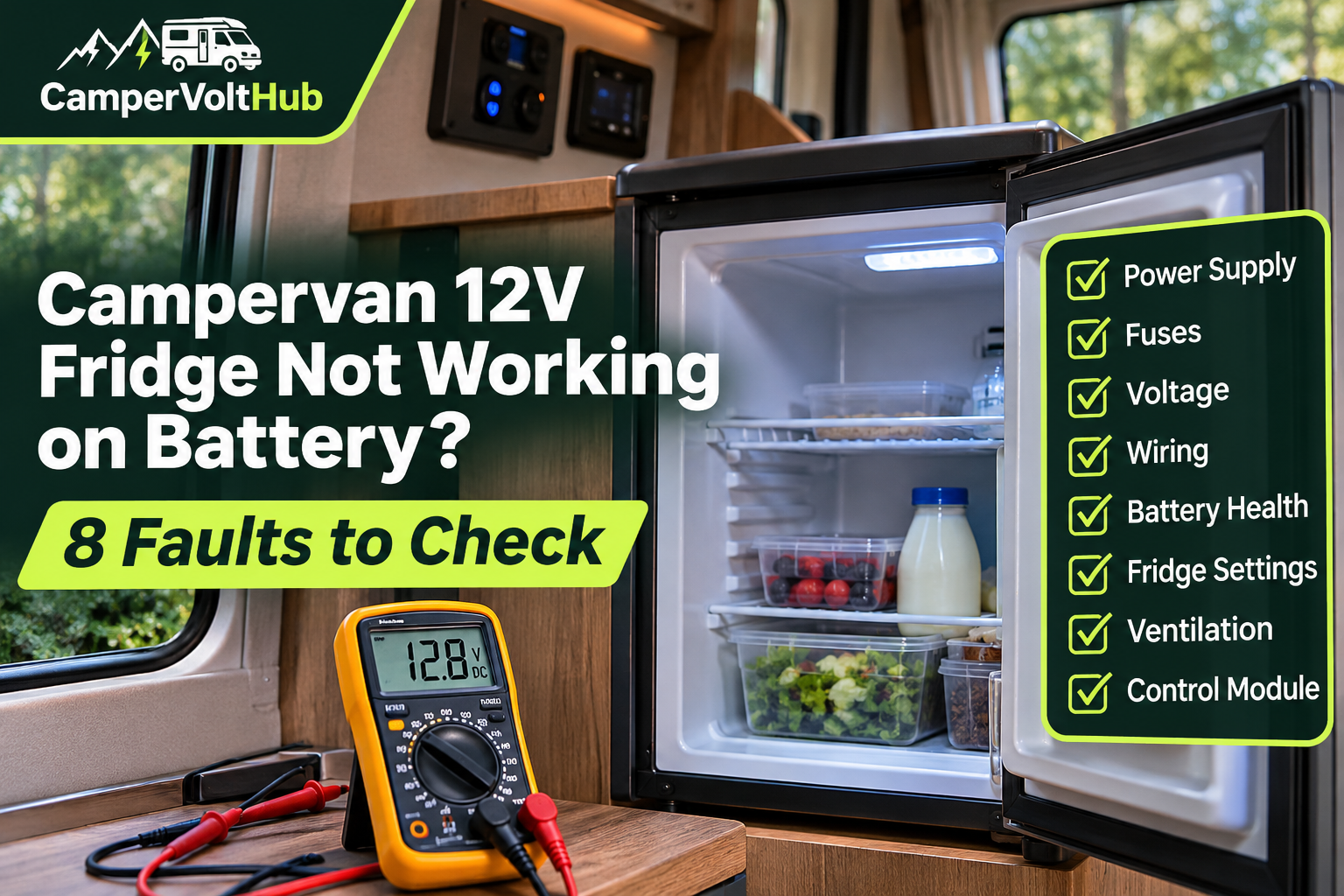
A campervan 12V fridge may stop working on battery power because of a disconnected supply, blown fuse, low battery voltage, excessive voltage drop, incorrect settings, poor ventilation, a faulty control module or a battery unable to supply the required starting current.
The best first check is to measure the voltage at the fridge’s DC input while it is attempting to start, then compare that reading with the voltage at the leisure battery.
A 12V compressor fridge is one of the most useful appliances in a campervan. It keeps food fresh without needing a mains hook-up, making it ideal for off-grid travel.
But when the fridge suddenly stops working on battery power, things can become frustrating very quickly.
You might find the display is completely dead, the compressor starts and stops, or the fridge works perfectly on electric hook-up but refuses to run when you’re parked off-grid.
These symptoms don’t necessarily mean the fridge itself has failed. Many problems originate in the 12V supply, battery condition, fuse protection or wiring.
In this guide, I’ll explain how to narrow down the fault logically before replacing expensive components.
Campervan batteries can supply very high fault currents. Use appropriately rated test equipment and follow the fridge and vehicle manufacturers’ instructions.
Never bridge battery terminals, bypass fuses or place a multimeter set to amps directly across a battery or power supply. Do not open a fridge’s sealed refrigeration circuit or work on live 230V equipment.
If safe access to the fridge terminals requires removing electrical covers or disturbing fixed wiring, use a competent technician.
How Does a 12V Campervan Fridge Work?
Most modern 12V compressor fridges use a DC-powered compressor to circulate refrigerant through a sealed cooling system.
The thermostat or electronic controller switches the compressor on and off to maintain the selected temperature.
Unlike a fridge running continuously at full power, a compressor fridge normally cycles according to temperature and cooling demand.
Many campervan compressor fridges draw approximately 30–60W while the compressor is running, although actual figures vary by model.
Some fridges operate from both 12V/24V DC and 230V AC, either through an integrated power supply or an approved external adapter. Other fridges are DC-only.
That distinction matters when diagnosing a fridge that works on hook-up but not on battery.
A fridge working while the van is connected to 230V hook-up does not automatically prove the 12V battery supply is healthy.
The fridge may be using a separate AC supply, or the battery charger may be raising the DC voltage enough to mask a weak battery or wiring problem.
8 Common Faults When a 12V Campervan Fridge Won’t Work on Battery
1. No 12V Power Reaching the Fridge
If the fridge display is completely dead and there is no sign of operation, the first possibility is that it isn’t receiving electrical power.
Possible causes include:
- The leisure battery isolator is switched off.
- The fridge circuit is disabled at the control panel.
- A connector has become loose or disconnected.
- A damaged wire has interrupted the supply.
- A relay or switching device isn’t operating correctly.
Don’t assume the fridge is faulty simply because the display won’t illuminate.
Confirm the battery and fridge circuit are switched on. Then measure the DC supply voltage at the fridge’s designated input terminals if they can be accessed safely.
If the correct supply voltage is present but the fridge remains completely dead, follow the manufacturer’s diagnostic procedure.
2. A Blown Fridge Fuse
Most properly installed campervan fridge circuits are protected by a fuse or another suitable protective device.
A blown fuse can completely interrupt the fridge’s electrical supply.
The fuse may be located in a 12V distribution board, an inline fuse holder or another manufacturer- specified position.
Some fridges also contain internal protective devices.
What to look for:- A fridge display that is completely dead.
- No voltage downstream of the protective device.
- Visible damage or overheating around a fuse holder.
- A fuse that repeatedly blows after replacement.
Safely isolate the circuit and test the removed fuse for continuity using a multimeter.
A sound conventional fuse should have very low resistance. A blown fuse normally reads open circuit.
Replace it only with the correct type and rating specified for the installation. If it blows again, investigate the fault rather than fitting a larger fuse.
For more on electrical protection, visit our Campervan Electrical Systems Guide .
3. Leisure Battery Voltage Is Too Low
Many compressor fridges include low-voltage protection to prevent excessive discharge of the supply battery.
When voltage falls below the manufacturer’s specified cut-out threshold, the compressor may stop running.
The fridge may restart automatically when the voltage rises above its reconnect threshold.
These thresholds vary between models and may depend on the selected battery-protection setting.
A battery that appears reasonably charged with no load may still experience a significant voltage drop when the compressor attempts to start.
Measure the leisure battery terminal voltage while the fridge is attempting to start.
Compare it with the fridge manufacturer’s operating voltage range and low-voltage cut-out settings.
If the battery is genuinely discharged, recharge it using the appropriate charging equipment.
If your leisure battery keeps losing charge, see our Leisure Battery Draining Overnight Guide .
4. Excessive Voltage Drop in the Fridge Wiring
This is an important fault to investigate when a fridge runs intermittently or refuses to start even though the leisure battery is charged.
Electrical resistance in cables, connectors, switches and fuse holders causes voltage to drop when current flows.
A fridge may therefore receive substantially less voltage than the battery itself is supplying.
Possible causes include:
- Undersized supply cables.
- Long cable runs.
- Loose or corroded terminals.
- High-resistance fuse holders.
- Poor negative return connections.
- Damaged or poorly crimped connectors.
Example Voltage Drop
Suppose the battery reads 12.6V while the compressor is attempting to start, but the fridge receives only 11.7V.
A 0.9V drop can be significant in a low-voltage installation and may cause some fridges to trigger low-voltage protection.
Compare battery terminal voltage with voltage at the fridge’s DC input while the compressor is attempting to operate.
Both measurements must be taken under comparable load conditions.
If the voltage drop is excessive for the fridge and installation, inspect the positive supply and negative return paths.
Our Campervan Electrical Planning Tools can help with cable and voltage-drop planning.
5. Incorrect Fridge Settings or Operating Mode
Sometimes the electrical supply is healthy, but the fridge isn’t operating because of its settings.
Depending on the model, possible causes include:
- The fridge is switched off at its own controls.
- An incorrect operating mode is selected.
- The thermostat is set incorrectly.
- A battery-protection setting is too restrictive.
- The control panel is displaying an error condition.
Some dual-input fridges automatically select between AC and DC power. Others require a specific operating mode.
Consult the fridge’s operating manual. Confirm the power source, thermostat and battery-protection settings are correct.
Record any error code before resetting the appliance.
6. Poor Ventilation or Overheating
Compressor fridges need adequate ventilation to release heat from their condenser and cooling components.
Restricted airflow can reduce cooling efficiency and cause some units to overheat or enter protection mode.
This is particularly relevant in compact campervan furniture where ventilation openings may be obstructed.
Check for:- Blocked ventilation grilles.
- Insufficient clearance around the unit.
- Dust accumulation.
- Very high surrounding temperatures.
- Cooling fans that are not operating as intended.
Inspect accessible ventilation openings and ensure the fridge is installed according to the manufacturer’s clearance requirements.
Do not dismantle sealed refrigeration components or defeat thermal protection devices.
7. Faulty Control Module, Thermostat or Temperature Sensor
If the fridge receives the correct voltage but the compressor won’t operate, the fault may be inside its control system.
Depending on the appliance design, possible faults include:
- Electronic control module failure.
- Faulty thermostat.
- Defective temperature sensor.
- Damaged internal wiring.
- Compressor or motor-control fault.
Many modern fridges provide fault codes or diagnostic indicators.
These codes are usually much more useful than replacing parts based on symptoms alone.
Confirm that the external power supply is within specification under load.
Record error codes and follow the manufacturer-specific diagnostic procedure.
Internal module replacement or compressor diagnosis should be carried out by a suitably competent technician.
8. Your Leisure Battery Cannot Supply the Required Current
A battery can show a reasonable voltage when nothing is connected but struggle when a compressor attempts to start.
Possible explanations include:
- Low state of charge.
- Battery ageing and reduced capacity.
- High internal resistance.
- Low-temperature operating restrictions.
- A lithium BMS limiting or disconnecting output.
- Other appliances already drawing substantial current.
Compressor starting behaviour varies between fridge models. Some use electronic controls to manage starting current.
Don’t assume every fridge requires a large starting surge. Use the manufacturer’s specifications.
Measure battery terminal voltage while the fridge attempts to start.
Check the battery’s state of charge, condition, temperature and any BMS warnings.
If the battery voltage collapses under a modest load, investigate battery condition and connections.
Learn more in our Campervan Leisure Battery Guide .
How to Test a 12V Campervan Fridge With a Multimeter
A few carefully chosen voltage and continuity checks can help identify whether the problem is in the battery supply, wiring or fridge itself.
Test 1: Check Leisure Battery Voltage
- Set your meter to DC volts. Select a suitable range for a nominal 12V system.
- Measure at the battery terminals. Follow safe probing procedures and avoid accidental short circuits.
- Record the resting voltage. Note whether the battery has recently been charged or discharged.
- Measure while the fridge attempts to start. A large voltage reduction may indicate a discharged or weak battery, excessive load or another supply issue.
A resting voltage reading is only a rough indicator of lead-acid battery state of charge.
It should not be used as a direct percentage indicator for LiFePO4 batteries.
Test 2: Measure Voltage at the Fridge
- Locate the approved DC input test points. Refer to the fridge’s installation manual.
- Measure supply voltage safely. Use DC voltage mode and appropriate insulated probes.
- Observe voltage during attempted operation. Ideally measure while the compressor is trying to start.
- Compare with battery voltage. Measurements should be taken under the same load conditions.
The acceptable voltage drop depends on the fridge’s requirements and the installation design.
A small drop is expected when current flows, but excessive drop can prevent reliable compressor operation.
Test 3: Check the Fridge Fuse
- Safely isolate the circuit. Follow the installation’s approved isolation procedure.
- Remove the relevant fuse. Confirm its identity from the wiring diagram.
- Set the meter to continuity or resistance. Never use resistance mode on an energised circuit.
- Test the removed fuse. A sound conventional fuse normally reads very low resistance, while a blown fuse reads open circuit.
If the fuse is blown, replace it only with the correct type and rating.
A repeatedly blowing fuse indicates a fault that requires investigation.
Test 4: Check Current Draw, If Necessary
Where appropriate, a suitably rated DC clamp meter or correctly installed current-measuring shunt can help establish whether the fridge is drawing current.
Compare the measured current with the manufacturer’s expected operating characteristics.
Never connect a multimeter set to amps directly across the battery or fridge supply.
Do not insert an ordinary multimeter into a high-current circuit unless the equipment and procedure are specifically rated for the task.
Campervan Fridge Troubleshooting Table
| Symptom | Possible cause | First check |
|---|---|---|
| Fridge completely dead | Missing supply, blown fuse or switching fault | Measure DC voltage at the fridge input |
| Works on hook-up but not battery | Weak battery, voltage drop or different AC/DC supply path | Identify power source and measure DC voltage under load |
| Compressor starts then stops | Low-voltage protection, wiring drop or control fault | Measure voltage during attempted start and check fault codes |
| Display on but fridge not cooling | Thermostat, control or refrigeration problem | Check settings and manufacturer error codes |
| Fridge works intermittently | Loose connection, voltage drop or thermal protection | Inspect supply voltage and ventilation |
| Fuse blows repeatedly | Electrical fault or incorrect protection arrangement | Stop replacing fuses and investigate the circuit |
| Fridge stops when another appliance starts | Supply voltage sag or excessive shared-circuit drop | Measure voltage at the fridge during combined load |
Quick Fixes to Try Before Replacing Your Fridge
- Confirm the fridge is switched on and the correct operating mode is selected.
- Check that the leisure battery is adequately charged.
- Confirm the fridge’s 12V circuit is enabled.
- Inspect accessible fuse holders for visible damage.
- Check for manufacturer error codes.
- Ensure ventilation openings are clear.
- Check whether the problem only occurs when other appliances are operating.
- Measure voltage at the fridge under load if it can be done safely.
If the fridge works when the battery charger is operating but stops when charging ends, don’t immediately replace the fridge.
Compare battery terminal voltage and fridge input voltage under load. The higher charging voltage may be masking a weak battery or excessive wiring voltage drop.
Could Your Leisure Battery Be Too Small?
A healthy 12V fridge can still use a significant amount of electricity over 24 hours.
For example, a fridge drawing 45W while running for eight hours in a day would consume:
This is normal energy consumption, not necessarily an electrical fault.
If the fridge works correctly but the battery runs flat overnight, investigate total electrical consumption and usable battery capacity.
Our Campervan Power Calculator can help estimate your requirements.
Work Out Your Campervan Power Needs
Find out how much electricity your fridge and other appliances consume, and estimate the battery capacity you need.
Try the Free Power Calculator →Frequently Asked Questions
Why does my campervan fridge work on hook-up but not on battery?
The fridge may be receiving power from a separate AC supply, or the charger may be raising DC voltage enough to mask a weak battery or wiring problem. Identify the actual power source and measure DC voltage under load.
What voltage does a 12V campervan fridge need?
The required operating voltage and low-voltage cut-out thresholds depend on the fridge model. Consult the manufacturer’s manual rather than relying on one universal voltage figure.
Can a low leisure battery stop a fridge from starting?
Yes. Many compressor fridges have low-voltage protection. If battery voltage falls below the relevant threshold, the compressor may stop or refuse to start.
How many amps does a 12V campervan fridge use?
Current depends on the fridge model and operating conditions. As an illustration, a 48W load at 12V draws approximately 4A. Check the manufacturer’s specifications for your particular fridge.
Can a blown fuse stop my campervan fridge working?
Yes. A blown fuse can interrupt the DC supply completely. Test the correct fuse safely and replace it only with the specified type and rating. Investigate repeated fuse failures.
Why does my fridge start and then immediately stop?
Possible causes include low-voltage protection, excessive wiring voltage drop, control faults or compressor-related problems. Check supply voltage during attempted operation and consult any error codes.
Can poor wiring cause a 12V fridge to stop working?
Yes. Undersized cables, long runs and high-resistance connections can reduce the voltage available at the fridge while current flows.
Should I replace the fridge if the display is completely dead?
Not before checking its electrical supply. A missing 12V feed, blown fuse or switching fault can make a healthy fridge appear completely dead.
Final Thoughts
If your campervan 12V fridge isn’t working on battery power, don’t assume the fridge itself needs replacing.
Start with the electrical basics: battery condition, supply voltage, fuses and wiring.
If the correct voltage reaches the fridge under operating conditions, investigate its settings, fault codes and internal controls.
Working through the problem logically can save time, money and unnecessary component replacement.
Safety note: This guide provides general educational information. Always follow the fridge and vehicle manufacturers’ instructions and use appropriate electrical safety procedures. Seek competent professional help when required.