
12 Volt Socket for a Caravan: Your Complete Guide
Everything you need to know about caravan 12V power sockets, including different socket types, what they can run, safe installation, fuse protection and common problems.
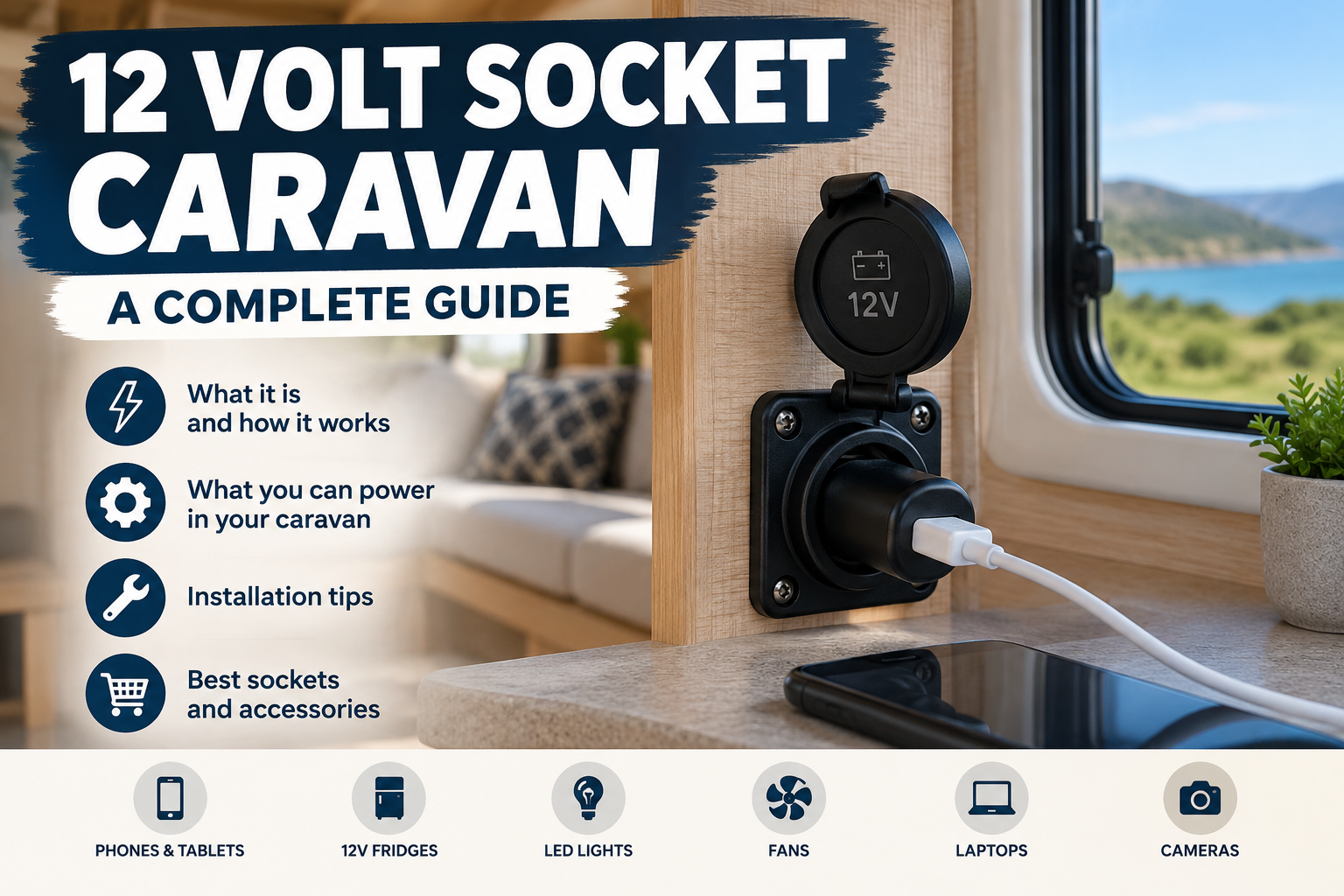
A 12 volt socket in a caravan is one of the simplest ways to power useful accessories without relying on a 230V electric hook-up. From charging your phone to running a small fan or a suitable 12V appliance, these sockets make life on the road much more convenient.
However, not all 12V sockets are the same. Some are designed for low-current accessories, others for higher-current equipment, and the type of socket you choose affects the plugs, wiring and protection you need.
In this guide, we’ll look at how caravan 12V sockets work, the different types available, how to choose one, what you can safely plug into it and how to troubleshoot a socket that stops working.
What Is a 12 Volt Socket in a Caravan?
A caravan 12V socket is a connection point that allows compatible electrical accessories to draw power from the caravan’s 12V system.
In a touring caravan, this power usually comes from the leisure battery, a suitable 12V power supply or the caravan’s electrical distribution system, depending on how the installation is designed.
Unlike a normal household socket, which supplies 230V AC in the UK, a typical caravan 12V socket provides nominal 12V DC power.
That makes it useful for equipment designed to operate from a 12V DC supply.
How Does It Work?
A basic 12V socket circuit includes a positive supply, a negative return, suitable protective wiring and a fuse or circuit breaker.
When a compatible plug is inserted, the appliance draws electrical current through the socket and its circuit.
The actual voltage can vary depending on battery chemistry, state of charge and whether charging equipment is operating.
If you’re unfamiliar with leisure battery systems, start with our campervan leisure battery guide, which explains the different battery technologies and their uses.
Different Types of 12 Volt Caravan Sockets
There are several socket styles commonly used in caravans, campervans and other leisure vehicles. The best choice depends on the equipment you want to connect.
Standard 12V Accessory Socket
This is the familiar cylindrical socket often described as a cigarette-lighter-style socket. It accepts compatible 12V accessory plugs used with chargers, fans and other portable devices.
Advantages: Widely available accessories, easy to use and convenient for portable equipment.
Limitations: Some plugs fit poorly or work loose under vibration. Socket and plug current ratings vary considerably.
Best for: General-purpose low-to-moderate-power accessories within the socket’s rated capacity.
DIN / Hella-Style 12V Socket
A DIN or Hella-style accessory socket is generally smaller than a conventional cigarette-lighter socket. Compatible plugs can provide a more secure connection.
These sockets are found in some motorcycles, specialist vehicles and leisure installations.
Advantages: Compact design and secure connection with a matching plug.
Limitations: Not directly compatible with all standard 12V accessory plugs.
Best for: Equipment designed for this connector type, especially where a secure connection matters.
12V USB Charging Socket
USB charging outlets convert the caravan’s DC supply into a regulated USB output suitable for compatible devices.
Modern options may include USB-A, USB-C and USB Power Delivery (PD), but the supported charging power differs between models.
Advantages: Convenient for phones, tablets, cameras and compatible laptops.
Limitations: A USB socket is not interchangeable with a general-purpose 12V accessory socket. Its internal electronics determine the output voltage and power.
Best for: Regular device charging without a separate plug-in USB adapter.
Dedicated 12V Power Connectors
Some caravan installations use dedicated DC connectors for higher-current or permanently installed equipment.
Examples include appropriately rated locking connectors and specialist DC power connectors.
Advantages: Can offer secure connections and clearly defined current ratings when correctly specified.
Limitations: Equipment and connectors must be compatible. They are not universal replacements for accessory sockets.
Best for: Purpose-designed installations where a standard accessory socket is unsuitable.
What Can You Power From a Caravan 12V Socket?
A 12V socket can run many useful accessories, provided the appliance is compatible with the supply and does not exceed the ratings of the socket, plug, wiring or circuit protection.
| Device | Illustrative power demand | Important consideration |
|---|---|---|
| Phone charger | 5–30W | Depends on charging adapter and device. |
| Small 12V fan | 5–25W | Check running current and startup behaviour. |
| LED reading light | 2–10W | Use a suitable 12V-rated fitting or adapter. |
| USB-C laptop charger | 30–100W or more | Requires a compatible DC-USB-C PD charger. |
| Portable compressor fridge | Often 30–70W while compressor runs | Check startup demand and plug/socket requirements. |
| Portable air compressor | Varies widely; can be high | May exceed standard accessory socket ratings. |
These figures are examples only. Always check the actual equipment specifications.
How Many Amps Does a 12V Appliance Use?
For a basic DC load, you can estimate current using:
Current (A) = Power (W) ÷ Voltage (V)
For example, a 60W device operating at 12V would draw approximately:
60 ÷ 12 = 5 amps
Real current may change with supply voltage and device operation. Motors and compressors may also have a higher startup current.
For help estimating your caravan’s overall power requirements, try our campervan electrical planning tools.
Can You Run a Kettle or Heater From a 12V Socket?
High-power appliances can draw very large currents from a 12V supply. For example, a 120W appliance would draw about 10A at 12V, while a 600W load would require roughly 50A before allowing for conversion losses.
That makes many high-power appliances unsuitable for ordinary 12V accessory sockets.
If you need to run a conventional 230V appliance, a correctly sized campervan inverter may be appropriate, but the inverter requires its own correctly designed DC supply and protection. Never attempt to power a high-current inverter through an accessory socket unless the entire arrangement is expressly designed and rated for it.
How to Choose the Best 12 Volt Socket for Your Caravan
Rather than choosing a socket purely by appearance or price, consider how it will actually be used.
1. Check the Current Rating
Look at the manufacturer’s stated continuous current rating for the socket and the matching plug. Some accessory sockets are rated at 10A, others at 15A or different values.
The usable limit is determined by the lowest-rated part of the circuit, not just the socket’s advertised rating.
2. Consider the Mounting Location
Flush-mounted sockets look neat inside cabinets and furniture panels. Surface-mounted sockets may be easier to install where there is limited space behind the panel.
Check clearance behind the mounting surface and keep wiring away from sharp edges, water sources and heat.
3. Decide Whether You Need USB-C
If you mainly charge phones and tablets, a dedicated USB-C charging socket may be more convenient than a standard accessory socket.
For laptops, confirm that the socket supports the required USB Power Delivery profiles and output wattage.
4. Consider Vibration and Plug Retention
Loose accessory plugs can cause intermittent operation and local heating. If your equipment needs a particularly secure connection, a compatible locking or DIN-style connector may be better.
5. Check the Quality of the Components
Choose a socket from a reputable manufacturer with clear specifications for operating voltage, current, mounting requirements and terminal connections.
Caravan 12V Socket Wiring and Fuse Protection
Correct wiring is one of the most important parts of a reliable socket installation.
A typical standalone 12V accessory socket circuit uses a positive supply from an appropriately protected distribution point and a negative return to the designated negative busbar or return connection.
Why Does a 12V Socket Need a Fuse?
A fuse or suitable circuit breaker protects the wiring against excessive current caused by overloads or faults.
The protective device must be selected according to the cable’s current-carrying capacity, installation conditions and the connected equipment. It must not be chosen solely because a socket is advertised as suitable for a particular amperage.
What Size Cable Should You Use?
There is no single cable size suitable for every caravan socket installation.
Correct sizing depends on:
- Maximum expected continuous and startup current.
- Total positive and negative cable length.
- Permitted voltage drop.
- How the cable is routed and installed.
- Temperature and grouping with other cables.
- The fuse or circuit-breaker specification.
Longer cable runs and higher loads generally require more attention to voltage drop and conductor sizing.
For a more detailed explanation, read our campervan cables and fuses guide.
Understanding Polarity
Most standard 12V accessory sockets use the centre contact as positive and the outer contact as negative, but always confirm the actual socket’s markings and instructions.
Reversed polarity can damage connected electronics. Verify polarity before using the newly installed outlet.
How to Install a 12 Volt Socket in a Caravan
Adding a 12V socket can be a practical upgrade, but the installation must suit the caravan’s existing electrical distribution and protection arrangements.
The following is a planning overview rather than a substitute for the manufacturer’s installation instructions or a wiring design.
Step 1 — Choose the Location
Select a dry, accessible position with sufficient space behind the panel for the socket body, wiring and connectors.
Step 2 — Identify a Suitable Power Supply
Check the caravan’s electrical documentation to identify an appropriate 12V distribution point. Do not assume that any nearby cable has sufficient capacity for an additional socket.
Step 3 — Calculate the Electrical Load
Identify the maximum power and current of the appliances you expect to connect, including relevant startup demands.
Step 4 — Design the Circuit Protection
Specify the cable, fuse or circuit breaker, connectors and negative return path as a complete circuit. Account for the existing installation and manufacturer requirements.
Step 5 — Isolate the Electrical System
Follow the caravan, battery and charger manufacturers’ instructions to isolate relevant power sources before working. A caravan may have multiple sources of electrical energy.
Step 6 — Mount and Connect the Socket
Fit the socket according to its instructions. Ensure wiring is protected from abrasion, secured against movement and terminated using suitable methods and components.
Step 7 — Verify Before Use
Check the installation for correct polarity, secure connections, suitable protection and safe operation. Have the work inspected and tested by a competent installer where appropriate.
Caravan 12 Volt Socket Not Working? Common Problems
When a 12V socket stops working, the fault is often in the supply circuit, the plug or the appliance rather than the socket itself.
| Problem | Possible cause | What to investigate |
|---|---|---|
| No power from the socket | Blown fuse, switched-off circuit or disconnected supply | Check the relevant circuit status and protective device. |
| Socket works intermittently | Loose plug, worn contacts or poor connection | Inspect for poor fit, damage and signs of overheating. |
| Fuse blows repeatedly | Overload, short circuit or faulty appliance | Stop using the circuit and identify the fault before replacing the fuse. |
| Phone charges slowly | Low-output USB adapter or voltage drop | Check charger output specifications and supply condition. |
| Plug becomes unusually hot | High resistance, poor contact or excessive current | Stop using it and inspect the socket and plug safely. |
| Socket works only on hook-up | Battery, distribution or switching arrangement | Check how the caravan’s 12V system is designed to operate. |
How to Check Whether a Socket Has Power
A suitable multimeter can help confirm whether DC voltage is present at the socket, but care is needed to avoid shorting the contacts.
Check the socket manufacturer’s contact arrangement and use suitable insulated probes or an appropriate test adapter. Do not force oversized probes into the outlet.
If the socket has voltage but the accessory doesn’t operate, investigate plug fit, voltage under load and the accessory itself.
If there’s no voltage, work back through the relevant circuit protection and supply using the caravan’s wiring information.
Frequently Asked Questions About Caravan 12V Sockets
Can I fit a 12 volt socket to my caravan?
Yes, provided the caravan’s electrical system can support the additional circuit and the socket is installed with correctly specified wiring, protection and connections. A competent installer can assess the existing distribution system.
Will a caravan 12V socket work without electric hook-up?
It may work from the leisure battery, depending on the caravan’s electrical design, battery condition and switching arrangements. Not every outlet is powered in every operating mode.
Can I use a car cigarette lighter adapter in a caravan?
Often yes, if the caravan has a compatible accessory socket and the adapter’s voltage and current requirements are within the circuit’s ratings. Always check the adapter specifications.
What fuse should I use for a caravan 12V socket?
The fuse must be selected for the complete circuit, including cable capacity, socket rating and expected load. There is no universally correct fuse rating for all caravan sockets.
Can I run a 12V fridge from a caravan socket?
Some portable 12V compressor fridges are designed for accessory sockets. Check the fridge’s current requirements, startup behaviour, plug type and the socket circuit rating. Other fridge types may need a dedicated supply.
Can a caravan 12V socket charge a laptop?
Yes, with a compatible DC laptop charger or suitable USB-C Power Delivery adapter. The adapter must support the laptop’s required charging profile and the socket circuit must support its input current.
Why does my caravan 12V socket keep blowing fuses?
Possible causes include excessive load, damaged wiring, a shorted plug or a faulty appliance. Do not increase the fuse rating. Identify and correct the underlying problem.
Is a 12V socket the same as a USB socket?
No. A standard 12V accessory socket supplies nominal 12V DC to compatible accessories. A USB charging socket contains electronics that provide regulated USB power according to its supported charging specification.
Can I connect a 12V socket directly to a leisure battery?
A dedicated battery-fed circuit is possible, but it must be designed with suitable overcurrent protection near the supply source, appropriately sized cables, secure connections and correct routing. Connecting a socket without proper protection is unsafe.
How much battery power does a 12V socket use?
The socket itself generally uses little or no power when nothing is connected, although illuminated or USB-equipped models may have a small standby draw. Power consumption mainly depends on the connected appliance.
More Caravan and Campervan Electrical Guides
If you’re improving your caravan’s 12V system, these CamperVoltHub guides can help with related equipment and electrical planning.
Campervan Leisure Batteries
Understand battery chemistry, capacity and choosing the right battery for your electrical needs.
Read the battery guide →Campervan Cables and Fuses
Learn why correct cable sizing and circuit protection are essential.
Explore cables and fuses →Campervan Solar Panels
Discover how solar charging can support your leisure battery.
Read the solar guide →Electrical Planning Tools
Estimate your daily power consumption and plan your electrical system.
Use the planning tools →Final Thoughts: Choosing a 12 Volt Socket for Your Caravan
A 12 volt socket is a practical addition to almost any caravan, providing convenient DC power for compatible accessories and charging equipment.
For everyday use, a quality accessory socket and a separate USB-C outlet can be a useful combination. For equipment with higher current demands, a purpose-designed connection may be more suitable.
The important things are to choose a socket that matches your appliances, ensure the wiring and protection are correctly specified, and investigate any signs of overheating or unreliable operation.
A properly installed 12V socket should be convenient, reliable and safe to use throughout your travels.
Disclaimer: This article provides general educational information. Electrical installations vary, and the correct design and testing procedures depend on the equipment and vehicle. Follow manufacturer instructions and applicable electrical standards, and consult a competent professional where appropriate.
1 thought on “12 Volt Socket for a Caravan: Complete Guide to Types, Wiring & Installation”