
Why Does My Campervan Water Pump Keep Blowing a Fuse? 9 Causes & Fixes
Does your campervan water pump keep blowing its fuse whenever you open a tap? Maybe the fuse blows instantly, or perhaps the pump runs for a few seconds before everything stops.
A repeatedly blown fuse is a warning that the circuit may be drawing too much current or has developed an electrical fault. Simply fitting another fuse will not solve the underlying problem.
This guide explains nine possible causes, how to distinguish a faulty pump from damaged wiring, and how to troubleshoot the problem safely.
Find the Cause ↓ Testing Guide →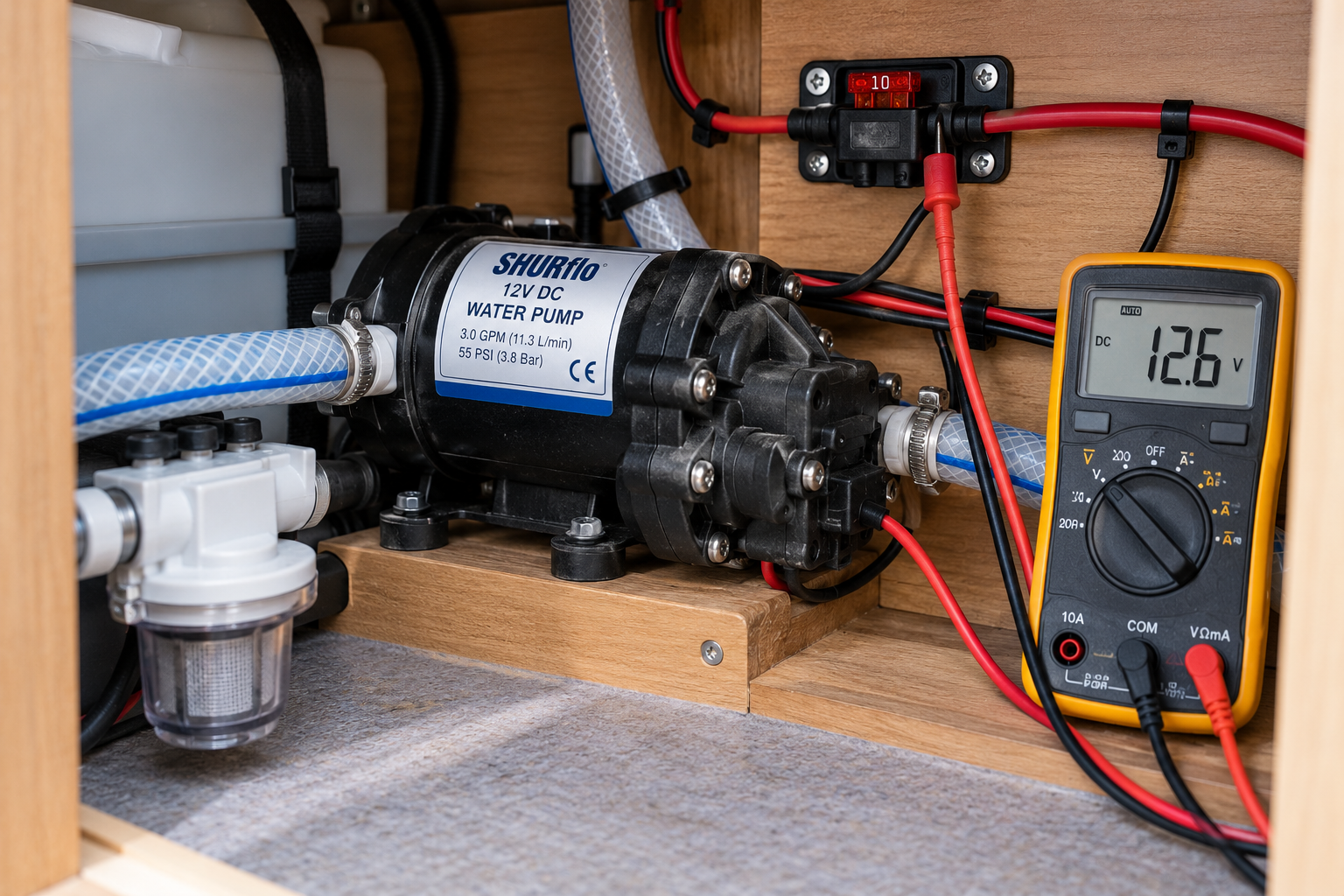
Quick Answer: Why Does a Campervan Water Pump Fuse Keep Blowing?
A campervan water pump fuse may blow because of a short circuit, damaged wiring, a faulty pump motor, a jammed mechanism or excessive electrical current.
The timing of the fault is an important clue.
If the fuse blows immediately when the pump circuit is switched on, a wiring short or internal electrical fault may be responsible.
If it blows only after the pump has been running for a while, excessive motor current, mechanical resistance or an installation problem may be more likely.
Water Pump Fuse Blowing: What the Symptoms Mean
Different symptoms can point towards different faults. Use this table to decide where to start looking.
| What Happens? | Possible Cause | First Check |
|---|---|---|
| Fuse blows immediately when switched on | Shorted wiring, incorrect connection or internal pump fault | Isolate supply and inspect the wiring |
| Fuse blows when a tap is opened | Pump motor fault, seized mechanism or wiring fault activated with the pump | Check the pump and its connections |
| Fuse blows after several seconds | Excessive running current, motor wear or mechanical resistance | Check pump operation and current draw |
| Fuse blows intermittently while driving | Chafed wiring or loose connections affected by vibration | Inspect cable routes and fixing points |
| Pump hums but no water flows | Jammed mechanism, blocked inlet, empty tank or priming problem | Stop the pump and check the water system |
| Fuse blows after replacing the pump | Incorrect pump specification, installation fault or unsuitable protection | Compare pump requirements with circuit design |
9 Reasons Your Campervan Water Pump Keeps Blowing a Fuse
1 Short Circuit in the Water Pump Wiring
A short circuit is one of the first faults to consider when a fuse blows immediately.
If a positive supply wire contacts the negative return or an earthed metal surface, a very high current can flow.
The fuse should interrupt this current before the wiring becomes dangerously hot.
Where to look:
- Wiring passing through metal panels.
- Cables trapped behind cabinets.
- Wiring near moving or vibrating components.
- Damaged insulation around the pump.
- Incorrectly connected terminals.
Possible fix: Isolate the circuit, locate the damaged section and repair or replace the wiring using suitable automotive electrical components.
For more information, see our Campervan Cables & Fuses Guide .
2 Seized or Partially Jammed Water Pump Motor
A pump motor may draw substantially more current when it cannot turn freely.
This can happen when a motor seizes, a diaphragm mechanism becomes damaged or internal parts create excessive mechanical resistance.
The pump may hum, vibrate or struggle to start before the fuse blows.
Signs to look for:
- The pump hums but does not run normally.
- Water flow is weak or absent.
- The pump becomes unusually hot.
- The fuse blows shortly after activation.
Possible fix: Switch off and isolate the pump. Follow the manufacturer’s instructions to inspect for mechanical obstruction or damage.
Do not repeatedly energise a stalled motor. A damaged or seized pump may need replacement.
3 Debris or a Jammed Pump Mechanism
Debris entering the water system can interfere with some pump designs.
Depending on the pump type, a blocked or jammed internal mechanism may increase motor load or prevent the motor from starting.
Sediment, damaged seals or fragments from ageing components can sometimes contribute to this problem.
What to check:
- The pump’s inlet strainer, if fitted.
- Visible debris in accessible components.
- Signs of internal mechanical damage.
- Whether the pump operates normally.
Possible fix: Clean serviceable components according to the pump manufacturer’s instructions. Replace damaged components or the pump where repair is not supported.
4 Water Pump Motor Windings Are Damaged
Electric motors contain windings that create the magnetic field needed for operation.
Overheating, ageing or insulation failure can damage these windings.
In some cases, internal short circuits increase current draw beyond the circuit’s normal operating range.
Possible symptoms:
- Repeated fuse failure with the pump connected.
- A burning smell from the pump motor.
- Intermittent operation.
- Excessive current draw during operation.
Possible fix: A pump with damaged internal windings will often require replacement.
Resistance measurements alone may not conclusively identify a winding fault, particularly on low-resistance DC motors.
5 Water Ingress or Corrosion Around the Pump
Campervan water pumps often operate in cupboards, under seating or near water tanks.
A leaking fitting or poorly protected electrical connection can allow moisture to reach terminals or internal components.
Water ingress may lead to corrosion, electrical tracking or a short circuit.
Check for:
- Leaking hoses or connectors.
- Wet electrical terminals.
- Green or white corrosion deposits.
- Damaged insulation or seals.
- Water staining beneath the pump.
Possible fix: Isolate the circuit, repair any water leak and replace damaged electrical components.
If water has entered a non-serviceable pump motor, replacement may be necessary.
6 Incorrect Fuse Rating or Fuse Type
The water pump circuit must use a fuse appropriate for the wiring, installation and equipment requirements.
A fuse with an unsuitable rating or characteristic may open during normal motor starting or operation.
However, repeated fuse failure should never be assumed to be caused by an undersized fuse without testing.
How to check:
- Identify the installed pump model.
- Read its current and fuse requirements.
- Check the existing fuse and holder.
- Verify that the circuit wiring is suitable.
- Confirm that no other loads share the fuse unexpectedly.
Possible fix: Correct the installation to meet the manufacturer’s requirements and proper wiring protection principles.
See our Campervan Fuse Box Guide for more information.
7 Faulty Pressure Switch or Pump Control Wiring
Many campervan diaphragm pumps include a pressure switch that starts and stops the motor as water pressure changes.
Other installations use microswitch taps, relays or separate pump switches.
A damaged switch, incorrectly connected control wire or shorted component can create a fault when the pump is activated.
The switch itself does not normally increase motor current simply by turning the pump on.
The concern is damaged wiring, an internal short or a control fault that energises an abnormal circuit path.
What to check:
- Pressure-switch connections.
- Microswitch tap wiring, where fitted.
- Relay terminals and wiring.
- Signs of moisture or heat damage.
Possible fix: Repair or replace the faulty control component after identifying the cause.
8 Worn Motor or Excessive Running Current
A pump may continue working even as its motor or mechanical components deteriorate.
Worn bearings, damaged internal parts or abnormal friction can increase the current required to run the pump.
The fuse may hold during startup but open after the motor has been operating for some time.
How to check: Measure operating current using a suitable DC current clamp or an appropriate test method, then compare it with the manufacturer’s specifications.
Possible fix: If the pump consistently draws excessive current and the external circuit is sound, servicing or replacement may be required.
9 Incorrect Pump Replacement or Modified Wiring
If the problem started after replacing the pump or modifying the water system, revisit the installation.
The new pump may have different current requirements, or the wiring may have been damaged or incorrectly connected.
Some pumps draw more current than others even when their flow rates appear similar.
Check the following:
- The new pump’s voltage rating.
- Its normal and maximum current requirements.
- Manufacturer-recommended circuit protection.
- Correct positive and negative connections.
- Any added switches, relays or accessories.
Possible fix: Correct the installation and ensure the complete circuit is suitable for the replacement pump.
How to Test a Campervan Water Pump That Keeps Blowing Fuses
The safest and most effective approach is to separate a possible wiring fault from a fault inside the pump itself.
These steps describe a typical 12V DC campervan water pump circuit. Actual installations vary, so refer to the pump and vehicle manufacturer’s instructions.
Confirm Which Fuse Is Blowing
Locate the fuse protecting the water pump. Check whether it supplies only the pump or additional equipment.
Confirm the fuse type and rating against the circuit documentation and pump manufacturer’s instructions.
If other appliances share the circuit, they may also need to be considered during fault finding.
Inspect the Pump and Wiring
With the circuit isolated, inspect accessible wiring for damage.
Look closely at cable entry points, pump terminals, switches and connections near water fittings.
Check for chafing, trapped cables, corrosion, loose terminals and signs of overheating.
Check for Mechanical Problems
Inspect the water system for obvious restrictions, leaks or pump damage.
Check any accessible inlet strainer and follow the manufacturer’s service procedure.
Do not run the pump dry or dismantle sealed components unless the manufacturer permits it.
Separate the Pump From the Circuit
A competent person can isolate the supply and disconnect the pump at its designated connector to help distinguish a pump fault from a wiring or control fault.
Any subsequent circuit checks must follow an appropriate test procedure. Exposed disconnected terminals must be safely secured and insulated.
If a short remains in the supply wiring with the pump disconnected, investigate the harness and controls.
If the external circuit checks out, the pump becomes a stronger suspect, but further testing is needed before confirming the diagnosis.
Measure Pump Current Safely
Where the circuit is safe to energise, a suitable DC clamp meter can measure current in an individual pump conductor.
Compare the measured operating current with the manufacturer’s specification.
Some motors briefly draw higher current at startup. A meter with an appropriate inrush or peak-capture function may be needed to investigate this behaviour.
Repair the Fault Before Restoring Power
Once the cause is identified, repair the damaged wiring or replace the defective component.
Verify the fuse rating, cable protection, mounting and connections before restoring the supply.
Finally, confirm that the pump operates normally without abnormal noise, excessive current, overheating or leaks.
How Much Current Should a 12V Campervan Water Pump Draw?
There is no single correct current figure for every campervan water pump.
Current draw depends on the pump model, motor design, operating pressure, supply voltage and working conditions.
A small submersible pump may have very different electrical requirements from a higher-pressure diaphragm pump.
Understanding Watts and Amps
Electrical power is calculated using:
Power (W) = Voltage (V) × Current (A)
For example, a hypothetical 12V pump drawing 4A uses approximately:
12V × 4A = 48W
This is an illustrative calculation, not a recommended fuse rating.
Motor startup current may be higher than normal running current.
The correct fuse must be chosen according to the manufacturer’s requirements and the circuit’s wiring protection needs.
Our Campervan Cable Size Calculator can help with preliminary wiring calculations.
The Fuse Box Planner can help organise your 12V circuits.
Quick Water Pump Fuse Fault-Finding Flowchart
Use this decision guide to decide where to investigate first.
How to Stop Your Campervan Water Pump Blowing Fuses Again
Protect the Wiring
Use suitable cable protection, grommets and secure fixings wherever wiring passes through cupboards or panels.
Keep Connections Dry
Check for leaks near electrical terminals and use suitable connections for the installation environment.
Maintain the Water System
Follow the pump manufacturer’s instructions for strainer cleaning, winterisation and routine inspection.
Use the Correct Fuse
Confirm circuit protection against the pump specification and wiring design. Never bypass a blown fuse.
Check After Modifications
Recheck wiring, pump current requirements and circuit protection after replacing a pump or adding accessories.
Investigate Unusual Noises
A pump that hums, stalls or becomes unusually hot should be checked before further use.
Frequently Asked Questions
Why does my campervan water pump fuse blow as soon as I turn it on?
An immediate fuse failure may indicate a short circuit in the wiring, a faulty control component or an internal pump fault. Isolate the circuit and inspect the installation before further testing.
Why does my water pump fuse blow after a few seconds?
Possible causes include excessive motor current, mechanical resistance, internal motor damage or an unsuitable fuse specification. Electrical testing is needed to identify the actual fault.
Can a blocked water pump cause a fuse to blow?
A jammed internal pump mechanism can cause some motors to draw excessive current. However, a blocked water pipe does not automatically cause a blown fuse. The effect depends on the pump design.
Can a faulty pressure switch blow the water pump fuse?
Yes, if the switch or associated wiring develops an electrical short or another fault that causes excessive current. Ordinary switch operation should not cause a correctly designed circuit to blow its fuse.
What size fuse should a 12V campervan water pump have?
The correct fuse depends on the pump manufacturer’s requirements and the circuit wiring design. There is no universal fuse rating suitable for every 12V water pump.
Can I put a bigger fuse in my campervan water pump circuit?
Do not increase the fuse rating simply because the original keeps blowing. An oversized fuse may fail to protect the wiring and create a fire risk. Identify and repair the underlying fault.
Can a low leisure battery cause the water pump fuse to blow?
Low battery voltage can affect motor performance, but it does not automatically cause excessive current or a blown fuse. Investigate the actual current draw, pump condition and wiring rather than assuming the battery is responsible.
Why does my water pump fuse blow only when driving?
Vehicle movement can aggravate damaged or poorly secured wiring. Check for cables rubbing against metal, loose connectors and components affected by vibration.
How do I know whether the water pump motor is faulty?
A competent technician can inspect the pump, separate it from the external circuit and compare its electrical performance with manufacturer specifications. Excessive current, abnormal noise or internal damage can support the diagnosis.
Should I replace the pump if it keeps blowing fuses?
Not necessarily. Damaged wiring, faulty switches or an incorrect installation can produce the same symptom. Confirm the cause before purchasing a replacement pump.
Related CamperVoltHub Electrical Guides
Water pump faults are often connected to the wider 12V electrical system. These guides can help you understand the wiring and protection involved.
Troubleshooting Your Campervan Electrics?
CamperVoltHub provides practical electrical guides and free planning tools to help you understand your campervan’s 12V system.
Explore Free Electrical Tools →Final Thoughts
If your campervan water pump keeps blowing a fuse, resist the temptation to keep replacing it and hoping the problem disappears.
A fuse that repeatedly opens is telling you that something in the circuit needs investigating.
Start by noting when the fuse blows, then inspect the wiring, pump, control components and installation.
A short circuit may cause immediate fuse failure, while an overloaded or deteriorating pump motor may take longer to cause the fuse to open.
The most important step is to identify the underlying fault before restoring the circuit to normal operation.
With a methodical approach, you can avoid unnecessary pump replacements and keep your campervan’s electrical system operating safely.
3 thoughts on “Why Does My Campervan Water Pump Keep Blowing a Fuse? 9 Causes & Fixes”